
It was a long drive from Picos de Europa National Park to the city of Oviedo in the Principality of Asturias, Northern Spain. It was late in the day and we settled on our hotel’s restaurant (Hotel Fruela on Calle Uria) for our evening meal before getting an early night in preparation for a long day tomorrow of walking the streets of the old centre of Oviedo. Our hotel was very centrally located, just up the road from a large city park, Campo San Francisco, with the Asturian Parliamentary building on the corner at the end of our street.


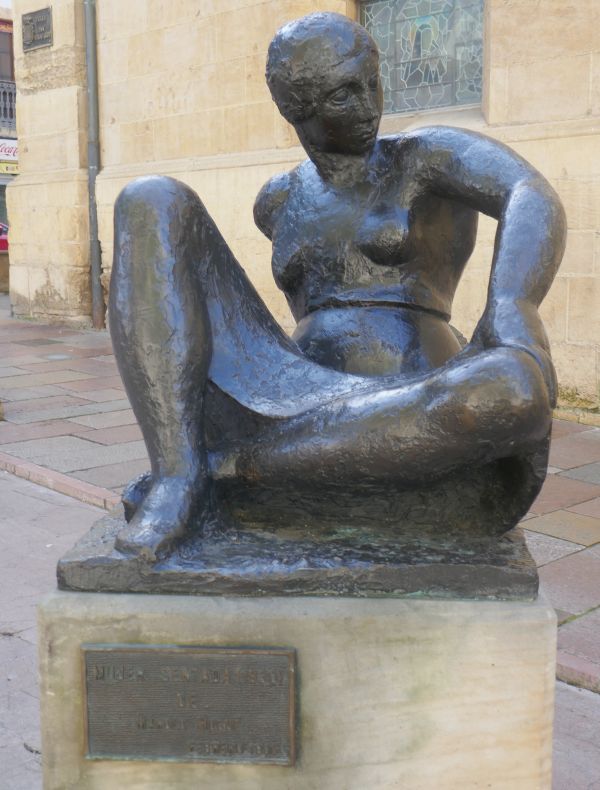
The photo to the right above shows the parliamentary building over the road from a sculpture (La Marternidad) that sits in the plaza la Escandalera. We very quickly became aware that the city fathers were keen to promote their city as a place where sculptures were everywhere as we explored Oviedo. For example, there were two sculptures that dominated our first plaza; two ponies stood not far from La Maternidad and by looking further along the street that ran off from our plaza, we could see more sculptures decorating the footpaths.
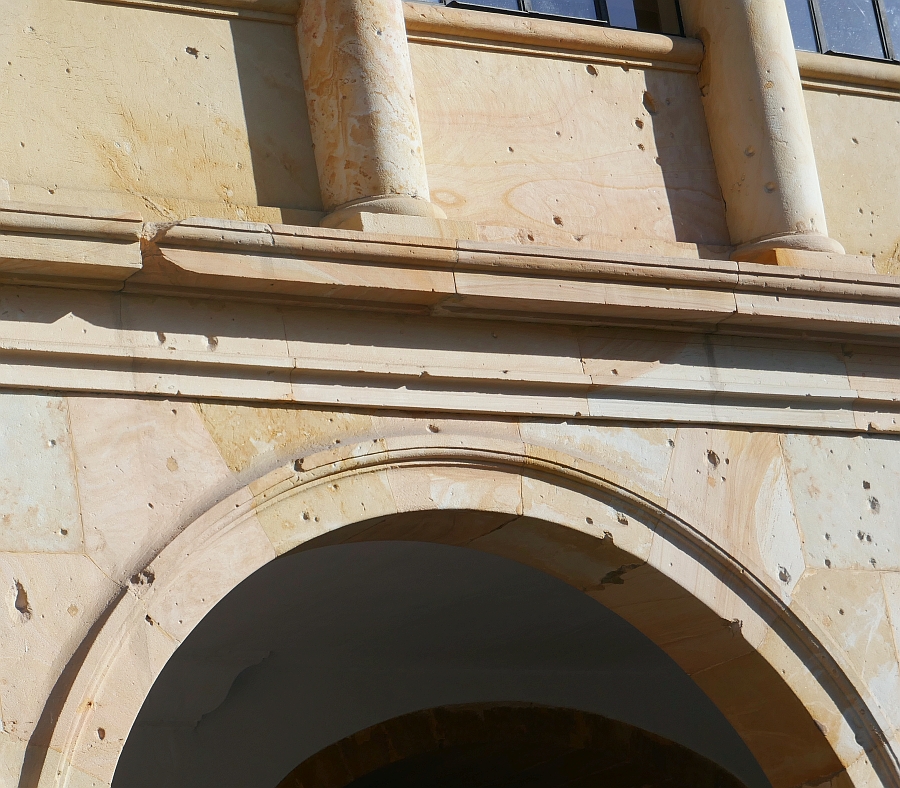
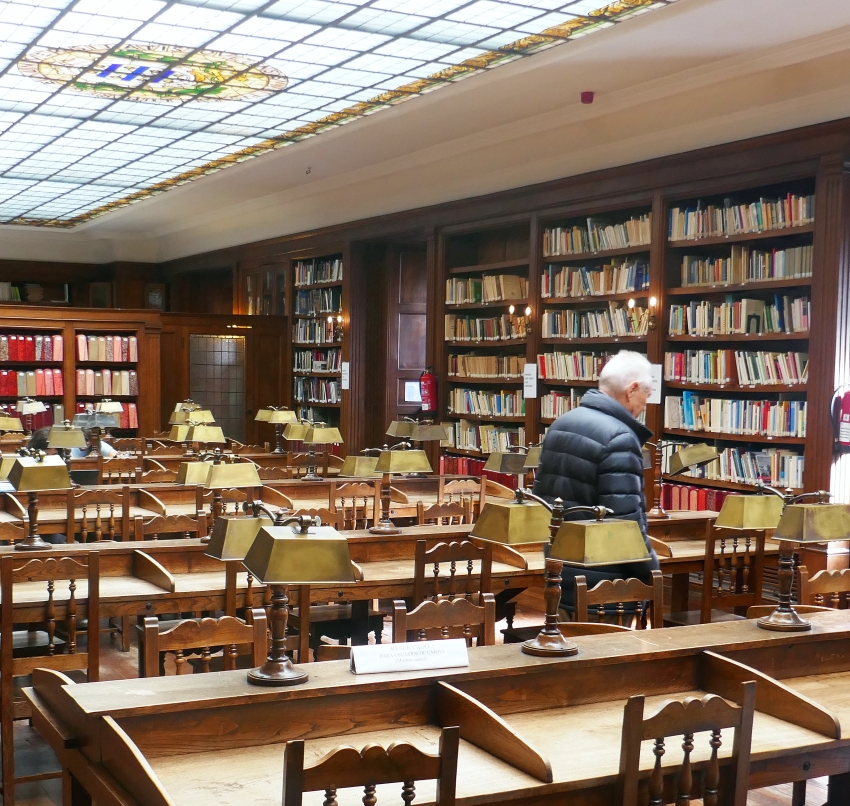
We had a local tour guide for the morning session of our stroll around Oviedo. She started the tour by taking us up Calle San Francisco to make a visit in the campus of the University of Oviedo. This was an ancient seat of learning in Spain having begun its classes in 1608. As our visit to San Sebastian had shown, the invasion of Spain by Napoleonic troops caused a lot of issues for Northern Spain; this university’s teaching was suspended until 1812. During the 20th century’s Civil War in Spain, there was a socialist-led miners revolt in Asturias and the strikers set fire to the university. The photos below were taken in the University courtyard that opens off Calle San Francisco. The photo on the right below shows bullet holes in the walls of the courtyard, another result of the civil war of the 1930s.

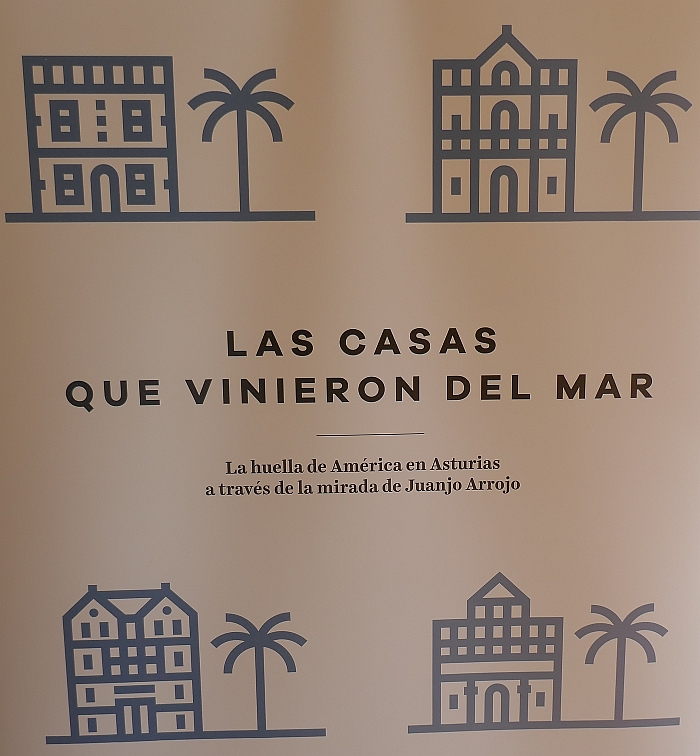
Our guide took us on a tour of the main building of the university. There was a display being held of the history of huge mansions built around Oviedo (“The Houses that came from the Sea”) that were built by returning citizens who had spent many years in the USA and had brought their fortunes home to build houses in their birth city.

From the university we continued slowly up-hill into Plaza Porlier. Here there is a complex sculpture called the Escultura El viajero (The Traveller) which depicts a man in a fedora and overcoat with his suitcases, looking very satisfied as if he has just returned to Oviedo.

The spire of the Oviedo Cathedral can be seen from Plaza Porlier and we walked in its direction, admiring a very ancient section of Iglesia de San Tirso el Real, a church that was established in the 790s. It was burnt down in the Great Fire of Oviedo in 1521 so the surviving section of the original church must be getting on for 1400 years old.
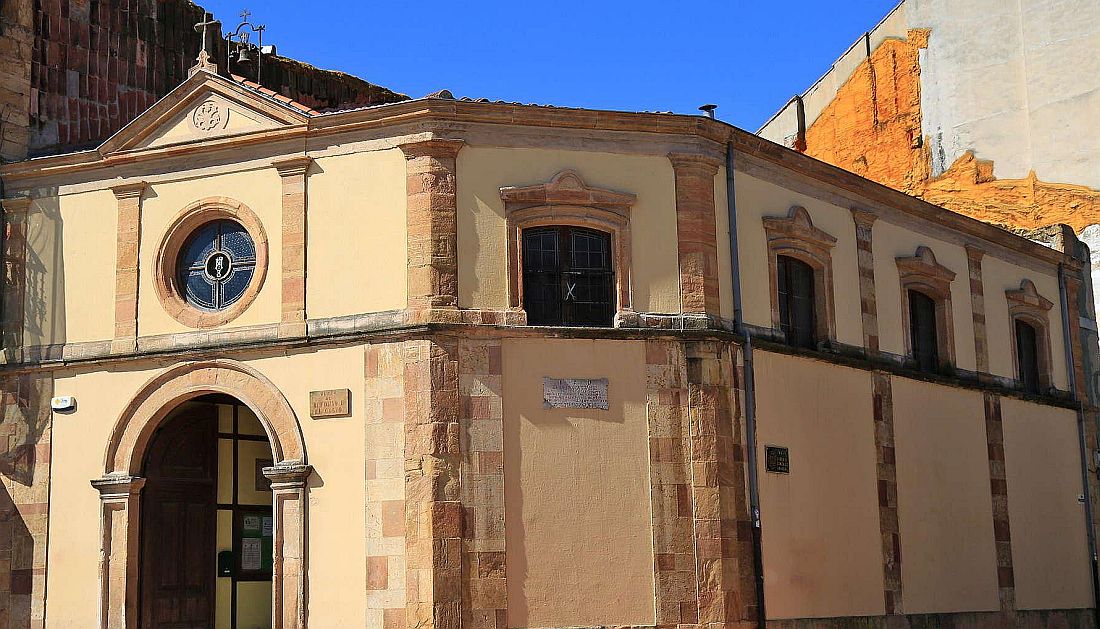

As we were heading towards the large plaza in front of the Cathedral (Plaza de Alfonso II el Castro), we passed the Balesquida Chapel (photo on left above) which is described as a “small Spanish Urban Chapel”, founded in 1232. There is no shortage of ancient places of worship in central Oviedo.
In one corner of the Cathedral Plaza we encountered a life size statue of a well-dressed lady who seemed to be promenading in the area. Her name was “Regenta” and the sculptor, Alvarez Fernandfez, based the well dressed woman from a novel by Leopoldo Clarin.
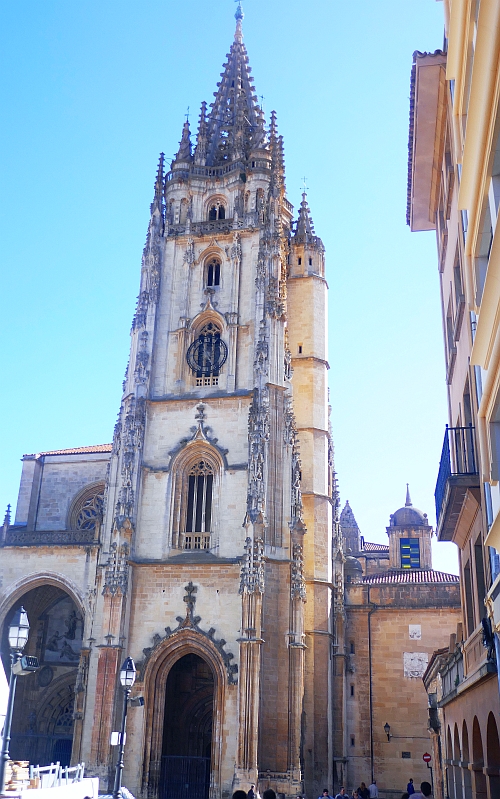

The Cathedral of Oviedo is quite spectacular when approached from the direction of the ‘Regenta’ statue. It is generally referred to as the Cathedral Basilica of the Holy Saviour. It was originally founded in the 8th century CE and like so many medieval Cathedrals has been renovated, restored and rebuilt over the last 1400 years. In particular over the two centuries starting in the fourteenth century, the old Romanesque cathedral was largely altered…eventually being rebuilt by the 16th century.

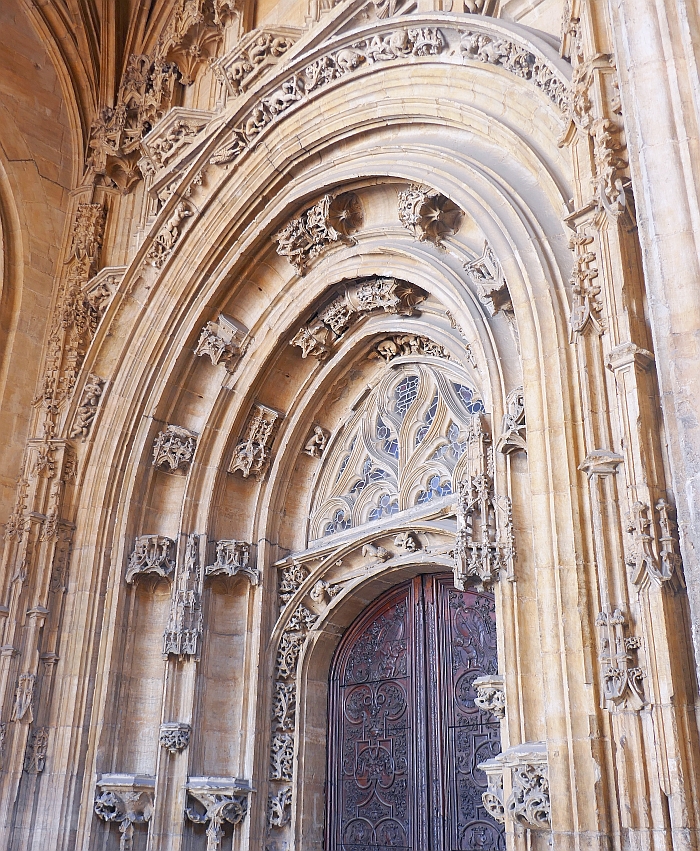
There were services being conducted inside the Cathedral on the morning we arrived at the door in the photo to the right above. A couple of respectful, suited gentlemen refused us entry and invited us to move on.
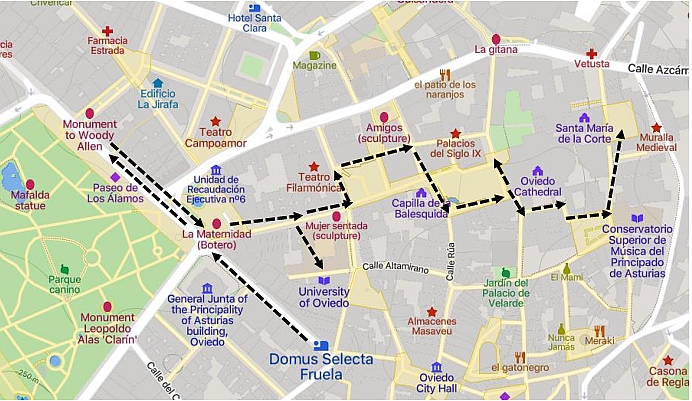
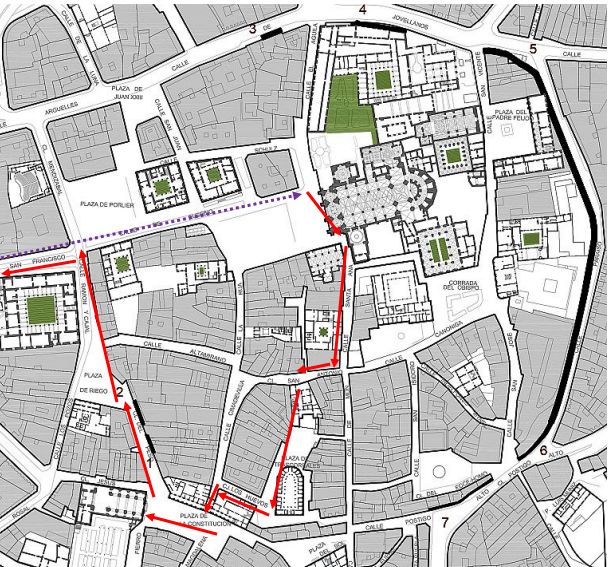
Like so many large cities in Spain, the modern city of Oviedo’s central area was once surrounded by medieval walls. The city itself began life on this site back at the start of the 8th century but its need for defensive walls came to the fore in the 12th century. The city centre that we were walking around was once inside defensive walls for many centuries and like so many other walled European cities, these walls lost their importance and instead became an impediment to the economic expansion of the city and so began to be demolished. The map below tracks our guided walk from the area around the Cathedral as well as illustrating the remnants of the 13th century walls. We didn’t get near the main section of remaining wall (the black line on the right side of map) but we did encounter some small sections of the wall towards the end of our tour.
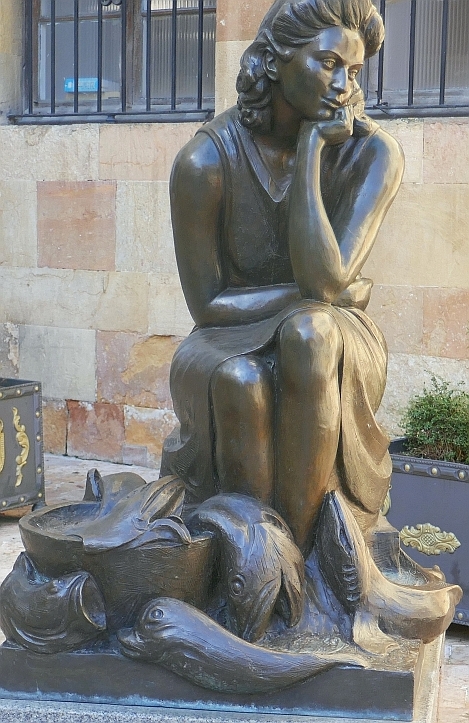
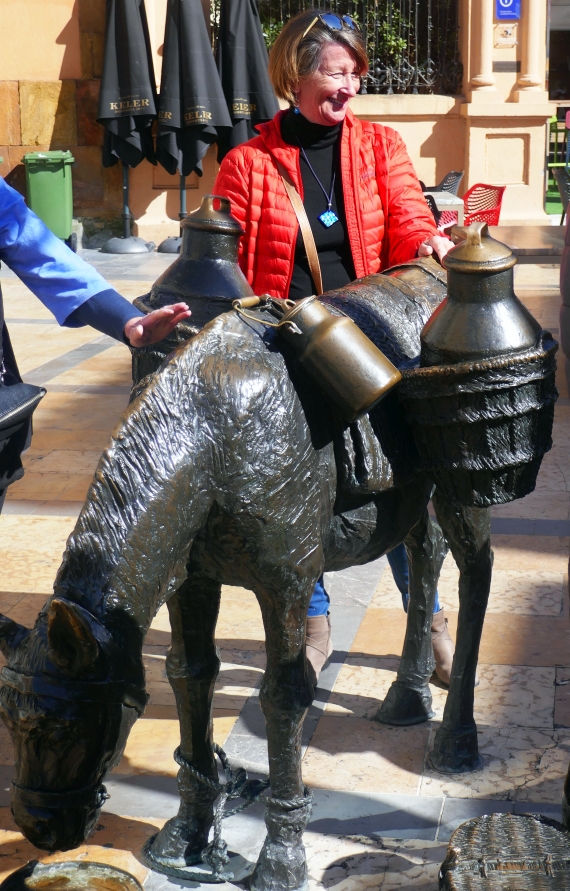

Our destination for this section of our tour was Plaza de la Constitution and we walked down Calle Santa Ana which led us to a plaza surrounded on all sides by high buildings. It is called Plaza Trascorrales and it is home to two of the loveliest sculptures from our whole walk around Oviedo. The first one is called La Pescadera (The Fishwife)…a character from a Spanish play is in the photo on the left above. Local tour notes comment; “The composition is famous for its sublime beauty and realism. People say that from time to time, the Pescadera actually seems to wake up from her thoughts and start looking at the passersby in surprise”. The second sculpture was of a group of figures called La Lechera (The Milkmaid) who stands in the plaza with her donkey that carries the milk cans, waiting for customers. (Photo in the middle above).
From this plaza we moved across to Calle Cimadevilla which provided us with a lovely exit into Plaza de la Constitution using the aptly named Cimadevilla Arch. It is used by pilgrims on their walk along the official version of the Pilgrim’s way as they trudge to Santiago de Compestella to pray at the tomb of St James. We didn’t realise the significance of our own route through Oviedo, otherwise we might have been more impressed with ourselves as we strolled though this impressive archway. (The other side of this archway can be seen in the photo on the left below).

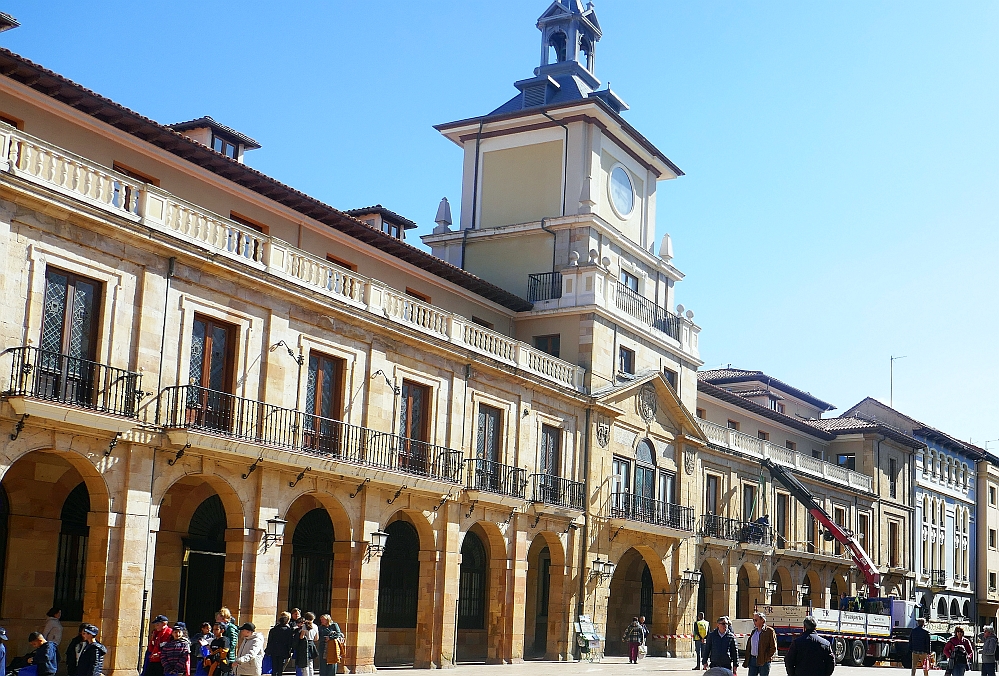
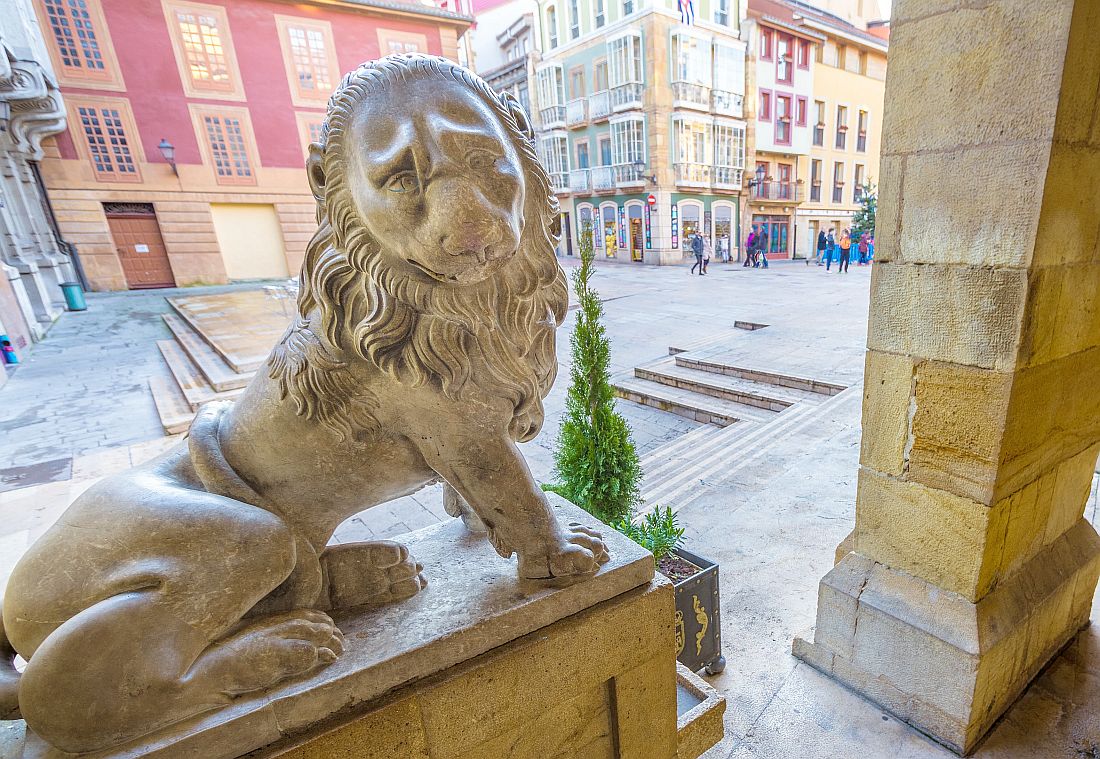
Plaza de la Constitution is a significant square in Oviedo and its most important building is the town hall, above right. It was built in the 17th century and it takes up most of one side of Constitution Plaza. I mentioned Oviedo’s ancient city walls earlier and its is interesting to note that the Town Hall was built on using recycled stones from the old town wall. The locals over the centuries had difficulty sticking with a name for this square, going through “City Square”, “Main Square”, “Royal Square.” as well as “Republic Square” when in 1873 King Amadeo I of Spain abdicated his throne. Below left is a 19th century Baroque lion that guards the pilgrim’s exit into Plaza de la Constitution.
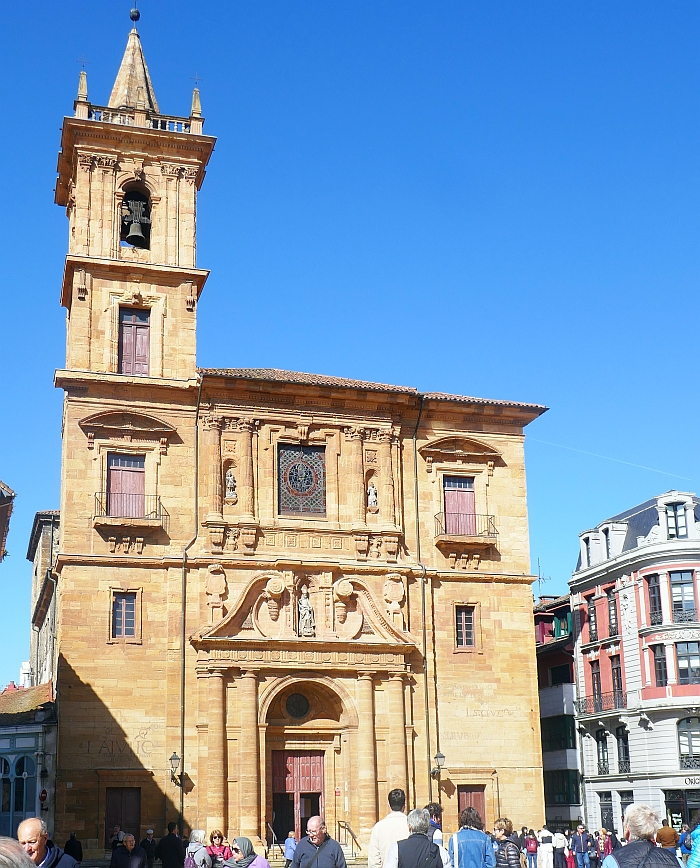
On west side of Constitution Square is the Church of San Isadora (above right) which is either a 16th or 17th church.

Referring back to the map of the surviving medieval walls of Oviedo, our route took us out of the western end of the Plaza de la Constitution, past the San Isadora church and up Calle el Peso and towards our next city square, Plaza de Regio. On the earlier map can be seen two numbers referring to surviving remnants of the old city wall that are located on the right of Calle el Peso.
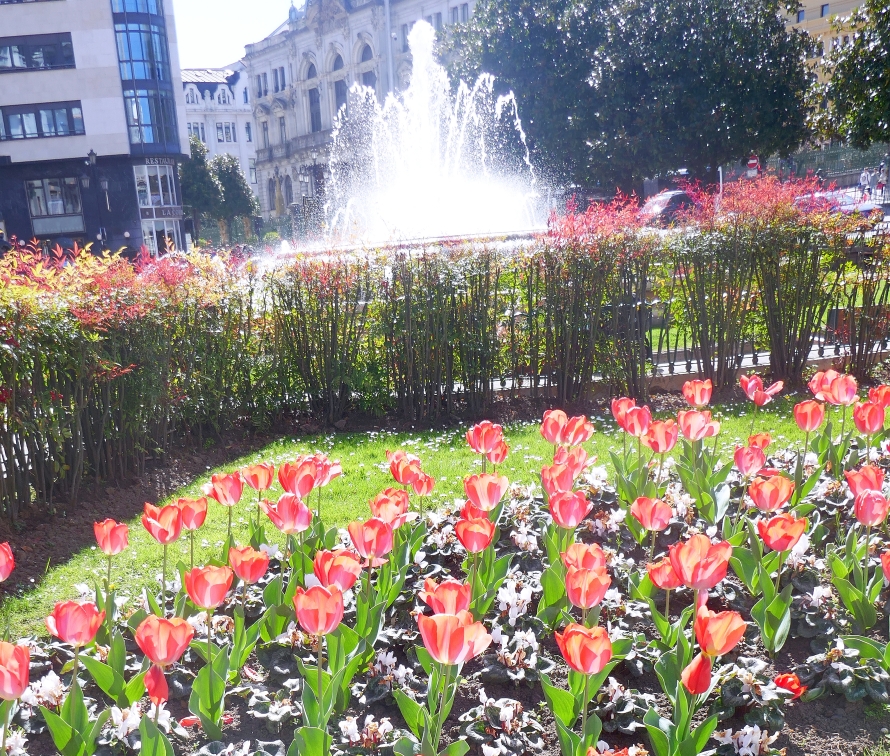
After leaving Plaza de Regio, our route back to Hotel Fruela was fairly straightforward. We passed the University of Oviedo, turned left at Calle San Francisco and we were soon back at Plaza la Escandalera where the gardens and fountain welcomed us back to our morning starting point.
The Morning After
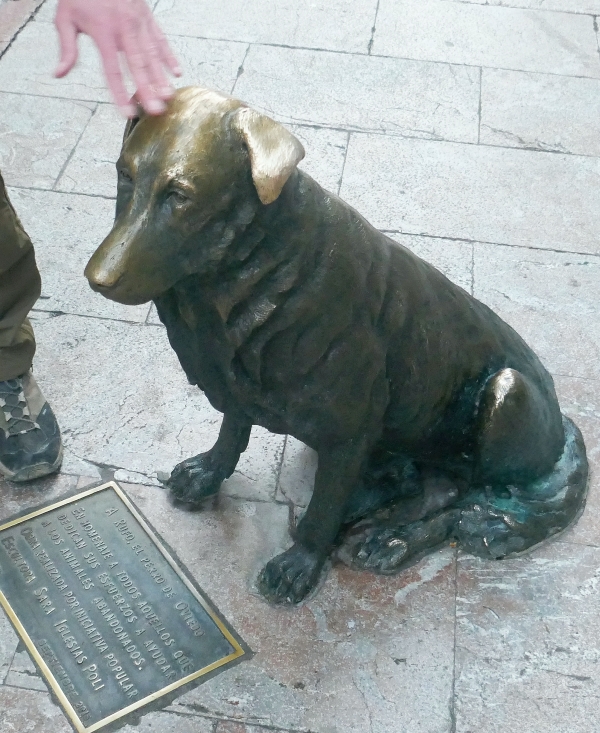
The final destination of our tour of Northern Spain the day after our tour of Oviedo was Santiago de Compestela. We had to be off immediately after breakfast but our guide decided we needed one more stop in Oviedo which was just along from Campo de San Francisco. Our first destination was the statue of Rufo, a stray dog that lived around the big park that was Camp de San Francesco and was a very popular sight for the locals who defended his right to live outside the usual ‘dog rules’ of Oviedo. He died in 1997 and the citizens demanded a statue to him in honour of all the dogs abandoned in the city.
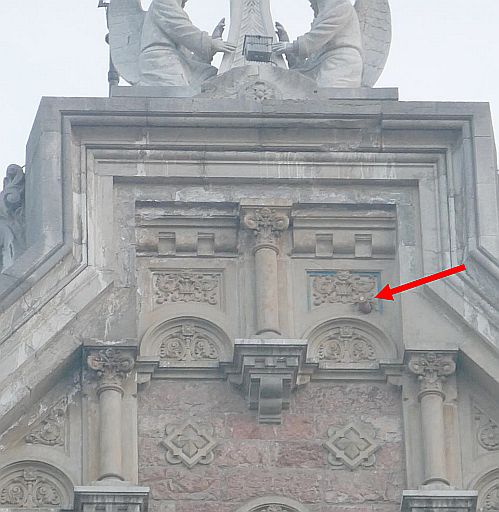
From the statue of Rufo the dog we walked down a street nearby to have a look at a church, the Iglesia de San Juan el Real. I was slightly surprised that we had stopped to look at another church before leaving Oviedo but I was happy to be guided. Its history was nowhere as long as any other church we had seen in Oviedo, having been built here between 1912-15 over the remains of the previous church that had been built in 832. The church has also achieved some fame as it is where the Spanish dictator Franco was married in 1923. After a few minutes of inspection, our guide asked us a curious question. Can you see the unexploded bomb in the façade of the church? During the civil war between 1936-39, Falangist rebels bombed Oviedo and one of these bombs embedded itself in the section of the church’s façade, just under the two angels who guarded the peak of the church’s façade… It hasn’t been removed for fear of damaging the church. We left town knowing that we had all just had our first sight sight of an unexploded bomb in a church façade!

The next stage of our journey is set out below.

 FOGTRAVEL