Safari Drive 4
It wasn’t long into our early morning Safari when our guide received a call on his radio to let him know that a large pride of lions had entered the local territory overnight and had brought down a buffalo. This trip to view a pride of lions just finishing off a major feast was a startling experience for us all!

I took the photo above as our jeep arrived not far from the large pack of lions. Amongst the trees on the left was a large male lion plus a few of his offspring, laid out on their backs as if they had had a long night on the booze and they didn’t care who saw them. To the right was the rest of the family, the female lions who had most likely done all the hard work of bringing the buffalo down and the younger cubs who now had full access to last night’s dinner.
The lion kill was the best show in town that day so it wasn’t long before our pride of place position at the lion kill had to be given up to the neighbours’ vehicles arriving to get a look at a day in the life of the local predators.
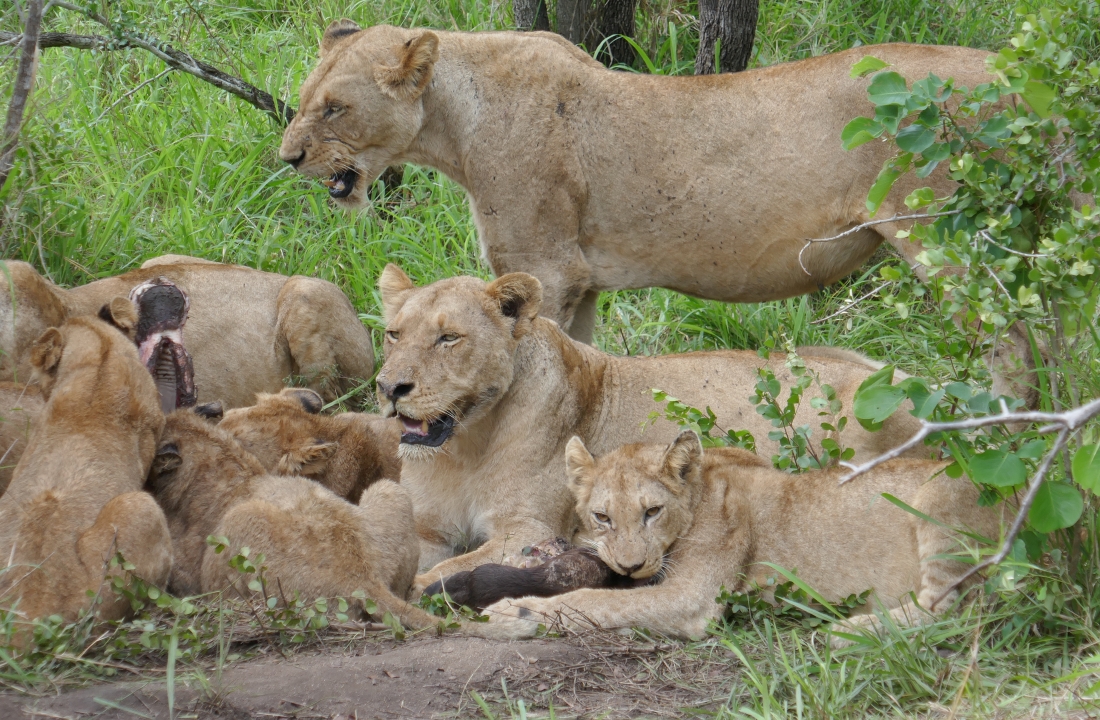
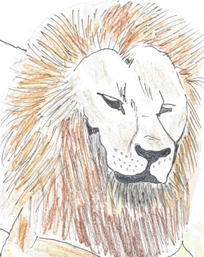
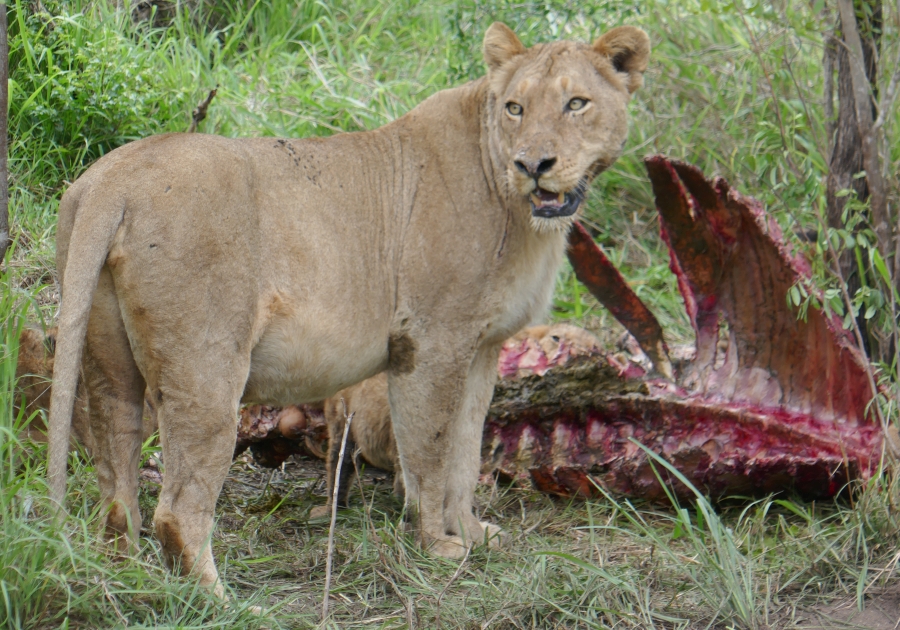
To watch the aftermath of the lion kill was a quite a confronting experience and I must admit that I was relieved when it was announced that our viewing time of the lions was over with the arrival of other jeeps so we headed off to find a nice peaceful spot where we could have a cup of tea and process what we had witnessed so early in the day.
I had mentioned in an earlier blog that we hadn’t encountered many elephants on our safaris so far but that was to change as we headed off from our encounter with the breakfasting lions. We caught up with a large family group of elephants that were slowly making their way through the open bushland. It meant that we were able to get a close up look at these huge beasts, slowly moving along ripping up grass and breaking off tree branches with their trunks and inserting the results up into their mouth under their trunk. The group appeared to consist of female elephants and their young. The baby elephants simply copied their mothers in the eating process while the white egrets followed along behind feeding off the disturbed insects.
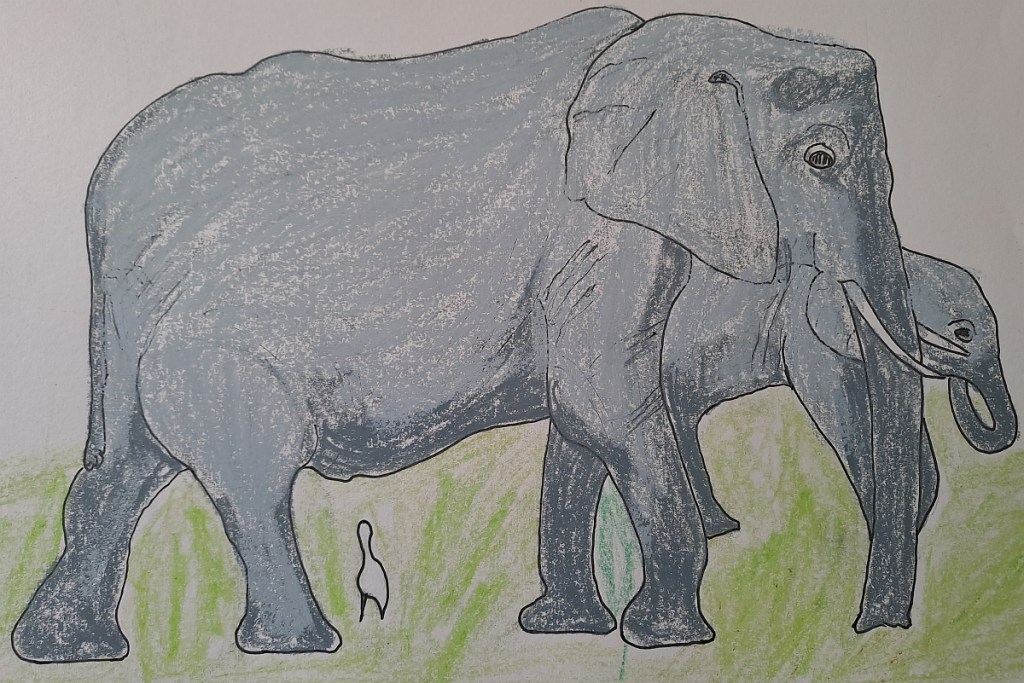
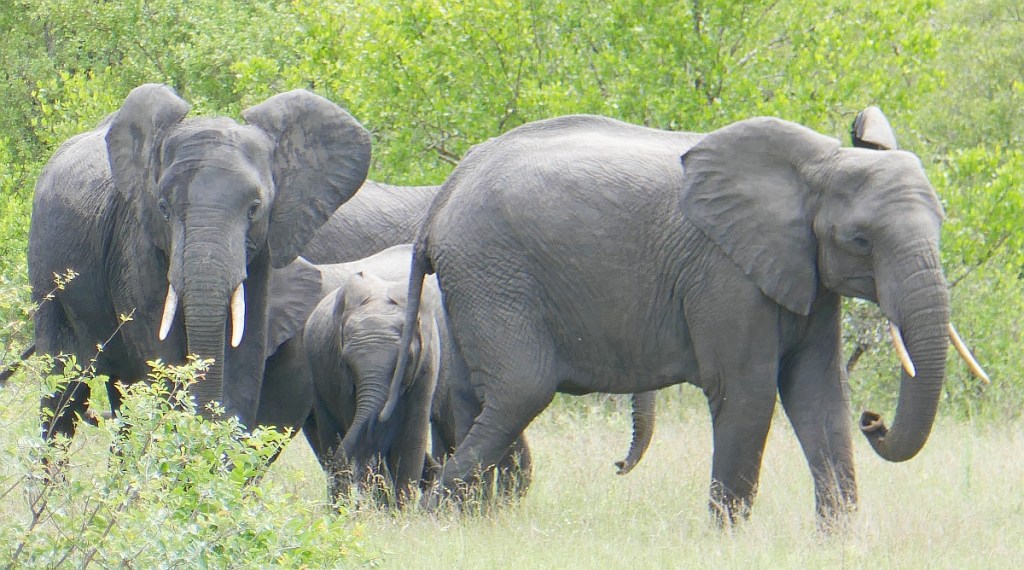
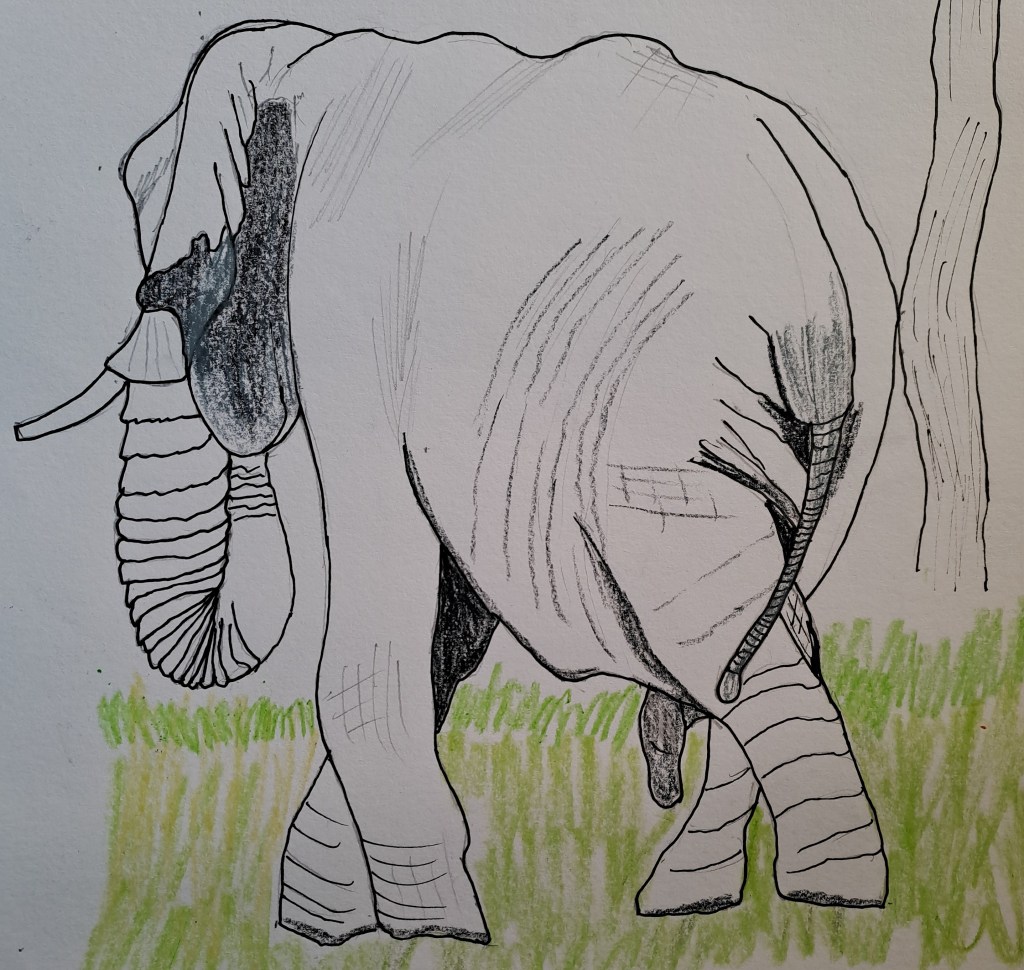
African elephants are the world’s largest land mammal and can weigh up to 7 tonnes. Some elephants live up to 70 years. One issue that I had never considered is the nature of the elephant’s trunk…it is in fact a modified nose and they can detect water under the ground with it..
The other feature of elephants that I had never pondered was the role of their tusks. They are generally used for assisting with finding food but when larger elephants come into conflict, a good set of tusks is important.
Elephants produce one calf every three or four years and the calves stay with the maternal groups of elephants as the group we followed illustrated.

One of the most impressive antelopes we encountered on our journey around both Kruger National Park and the Botswana delta was the Kudu. There are two species of Kudu. The ‘Greater Kudu’ and the ‘Lesser Kudu’ with the name suggesting that the Greater Kudu are much larger than the ‘Lesser’. The Lesser Kudu inhabit the thickets of the savannah and rarely are seen out in the open. Their striped pelts help with camouflage.
A Kudu horn is used by some folk as a musical instrument

It was our last morning safari in Londelozi and we were driving back to our base, following the elephants. It just so happened that the elephants path took them over the air-strip that we were leaving from in another couple of hours. We noticed that approaching the air-strip, the elephants grouped together in a line when it was time to cross over the concrete path of incoming planes. When they reached the concrete, the elephants sped up, looking like they knew that this was a dangerous spot to loiter and they should spend as little time as possible crossing over this dangerous territory.

 FOGTRAVEL