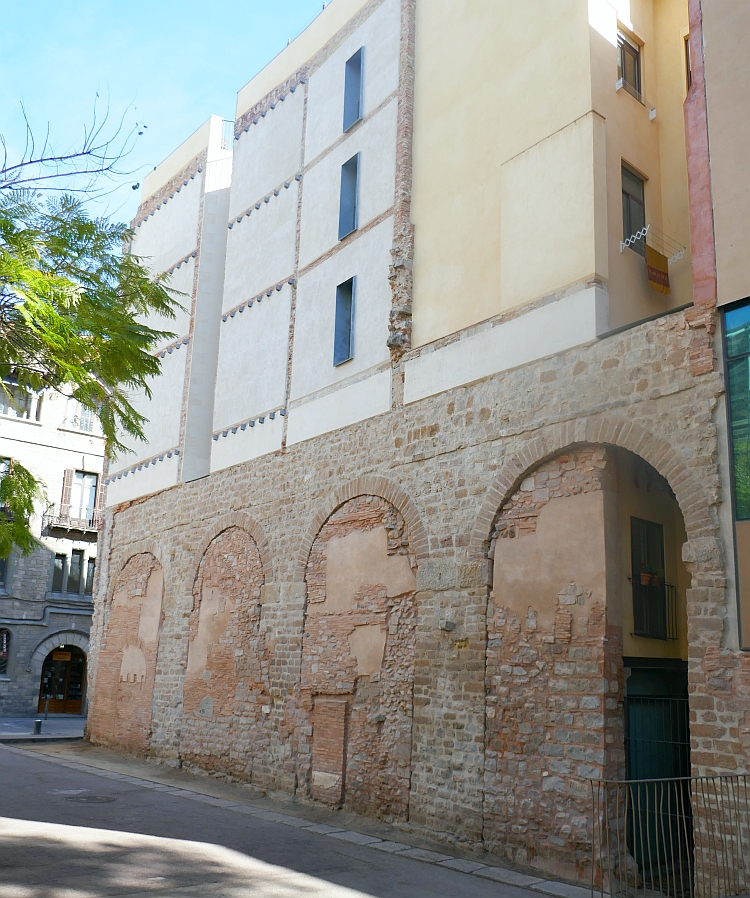
On our second day in Barcelona, I was up early to go for a walk around the area near our hotel. I found myself in Place del Vuit de Marc Square where I noticed two things that caught my attention. One appeared to be a Day Care Centre for pre-school age children with all the swings and roundabouts associated with their playground. The other was a large group of early-rising tourists who appeared to be finding interest in staring at the blank wall of a building that stood next door to the Day Care centre. I assumed it must have been of some historical interest so I decided to return with my small group of companions and check it out after breakfast. On our return later, we realised that what the early tourist group was looking at were the remnants of archways in the stone wall of the building (left below). They were the remains of the Roman Aqueduct that passed through this square and originally continued on to connect with Porta del Bisbe in the Cathedral Square. This almost 2000 year old memento of the Romans has survived due to some industrious folk deciding that it would make a better wall than anything they could produce

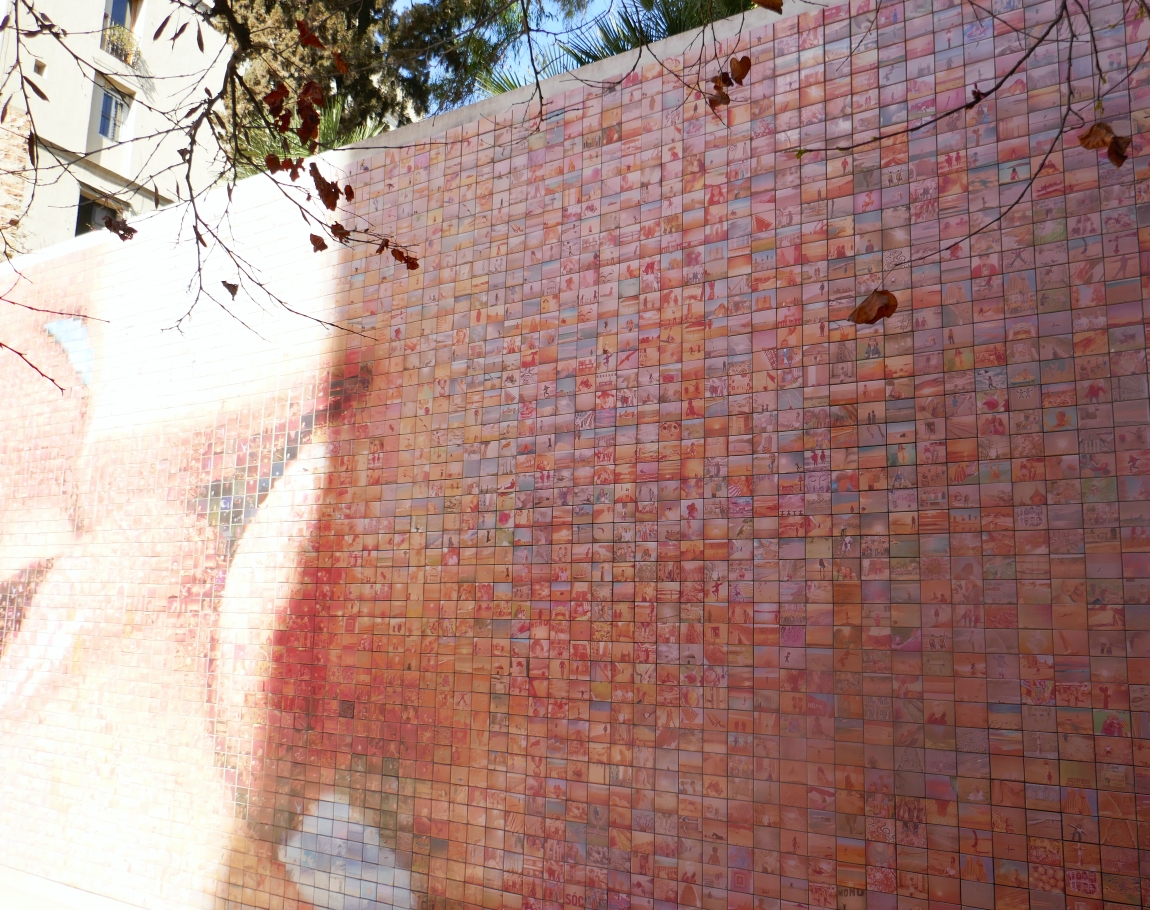
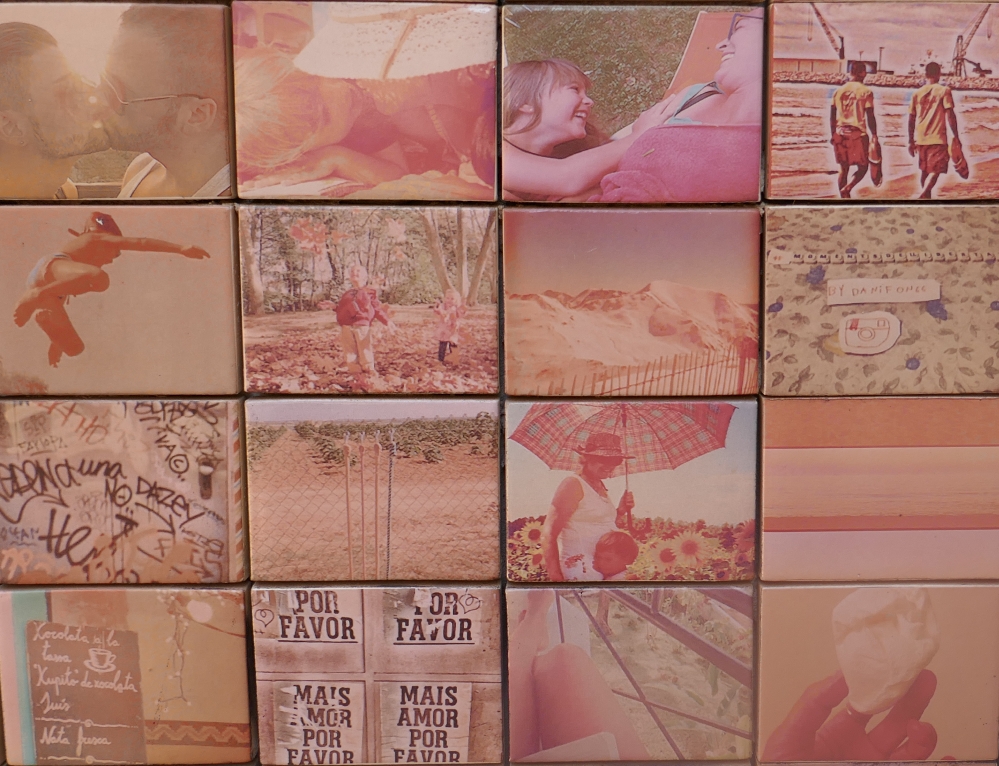
There was a laneway further on from the Aqueduct arches that we strolled through and found ourselves at another wall that appeared to be covered with small red/pink mosaic tiles. It seemed an attractive tiled wall until we got up close and discovered that each tile held a different image of folk going about their daily business. It is called the ‘Kiss Mural’. The artist asked local residents via the newspaper to send him photos representing a “moment of Freedom”. It was installed in 2014 as part of the celebrations commemorating the fall of Barcelona during the War of Spanish Succession. (1701-1715).
Like the night before when we headed for La Rambla looking for dinner, this morning we headed past Cathedral square and followed the alleyways down to the famous street that led visitors from the centre of the city all the way to the coastline. We came out into La Rambla opposite the food market, Mercado de la Boqueria. We spent a fair bit of time wandering the stalls of this market and unlike the many locals there, we didn’t need to spend our money on food and drink for our family that evening.

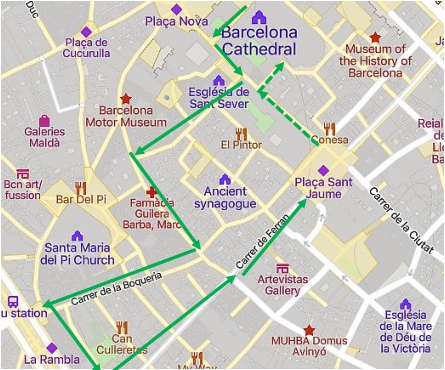
From this market-place, we headed for our next destination which was Place St Jaume, reached by heading down La Rambla and turning left at Carrer de Ferran. This large square is considered the centre of the old city of Barcelona and is the political and administrative heart of both the city and the region of Catalonia. On one side of the square is the City Hall of Barcelona (first photo below) and directly opposite is the Palace of the Generalitat (Second Photo below) which administers Catalonia. This appears to ensure that if political protesters need to gather and critique local politicians, this square conveniently gives them plenty of targets for protest!
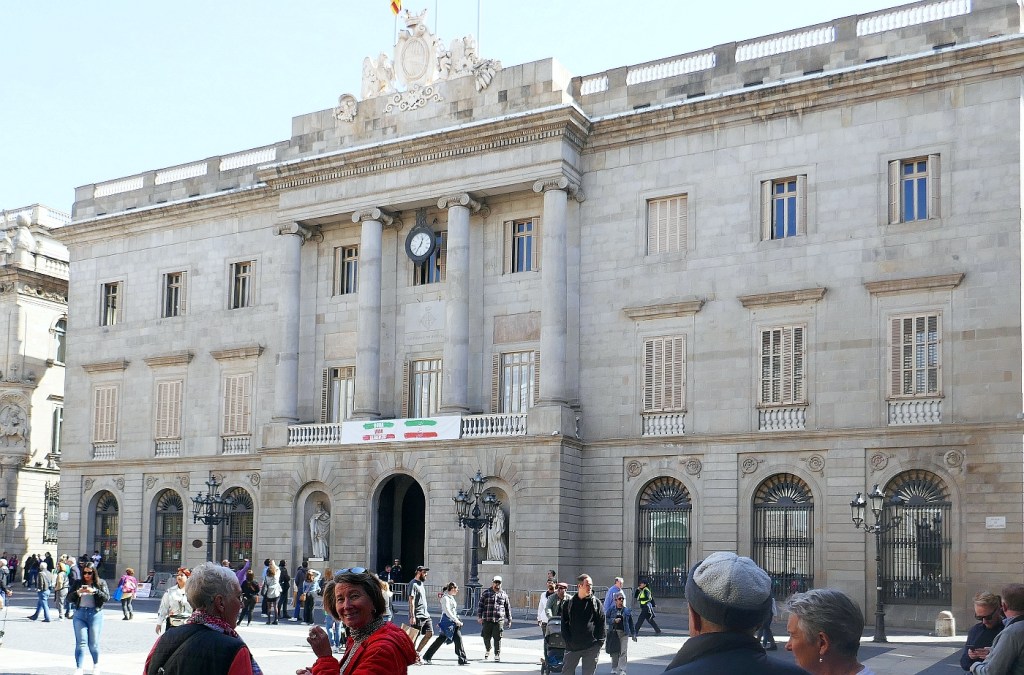

This administrative square, Placa St Jaume (St James), originally had a church here named after St Jaume which was demolished in the early 19th century. Of course the Placa also had more ancient origins as this was where the Roman forum once stood as well as the Temple of Augustus.
We decided we would head back in the direction of the Cathedral along Carrer del Bisbe. We were looking for one of the most photographed sites in Barcelona, the Bishop’s Bridge (El Pont del Bisbe), a Neo-Gothic ‘fly-over’ across the alleyway that heads up to the back of Barcelona Cathedral.
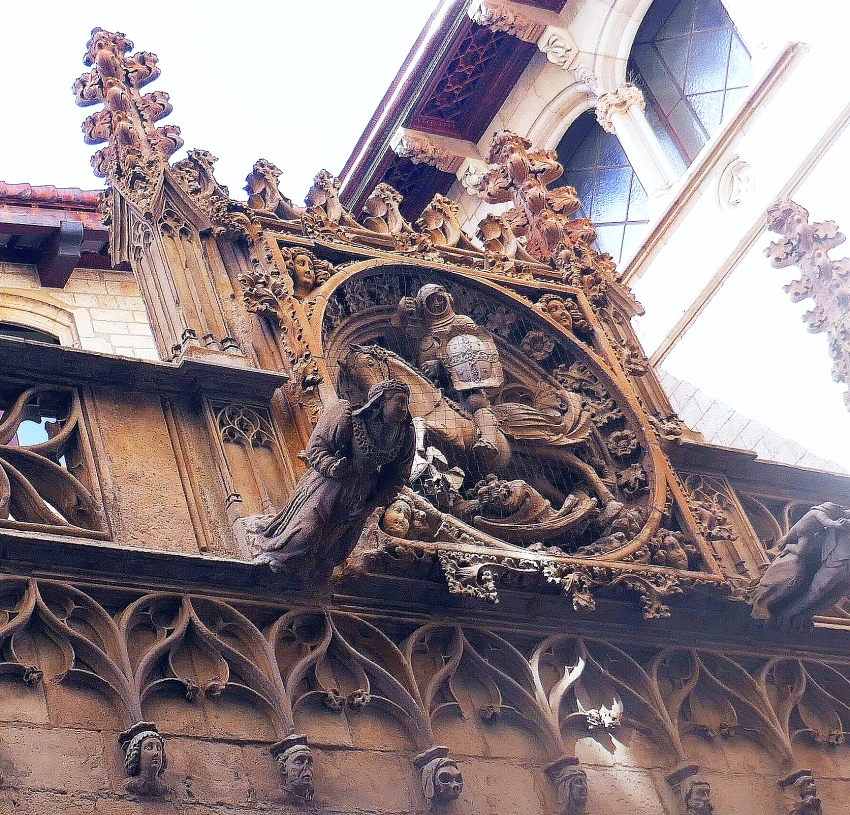
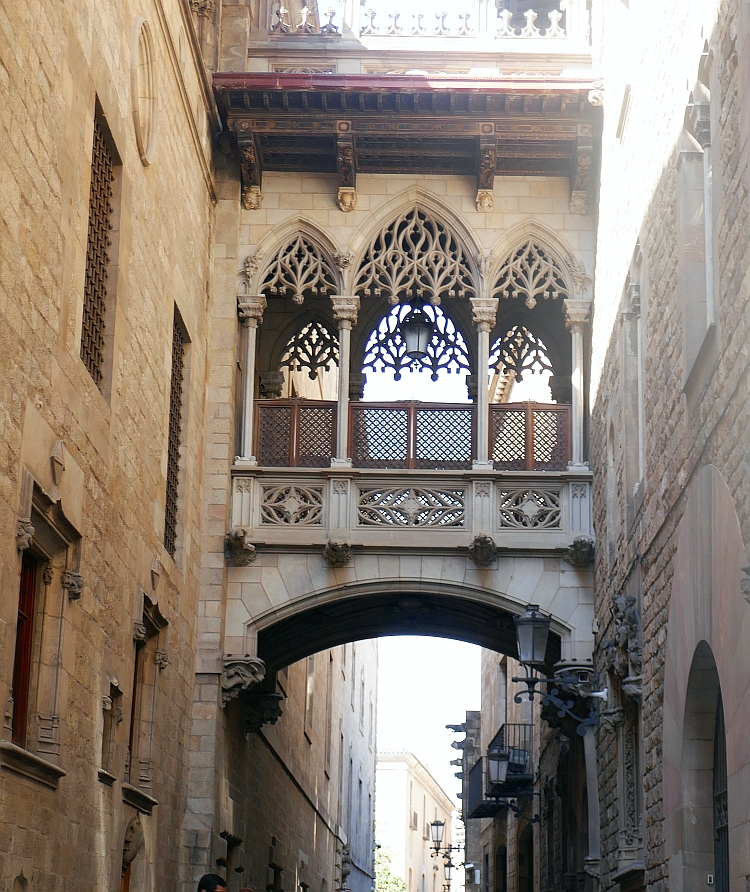
It is compulsory for a gothic bridge (above right) like this to also come with a creepy legend to worry the tourists. Under the bridge there is a skull with a dagger through it with a legend attached that if it’s ever removed, the city will be destroyed. Another tale is that it was just an expression of revenge by the architect whose further plans for the area were rejected by the local council.
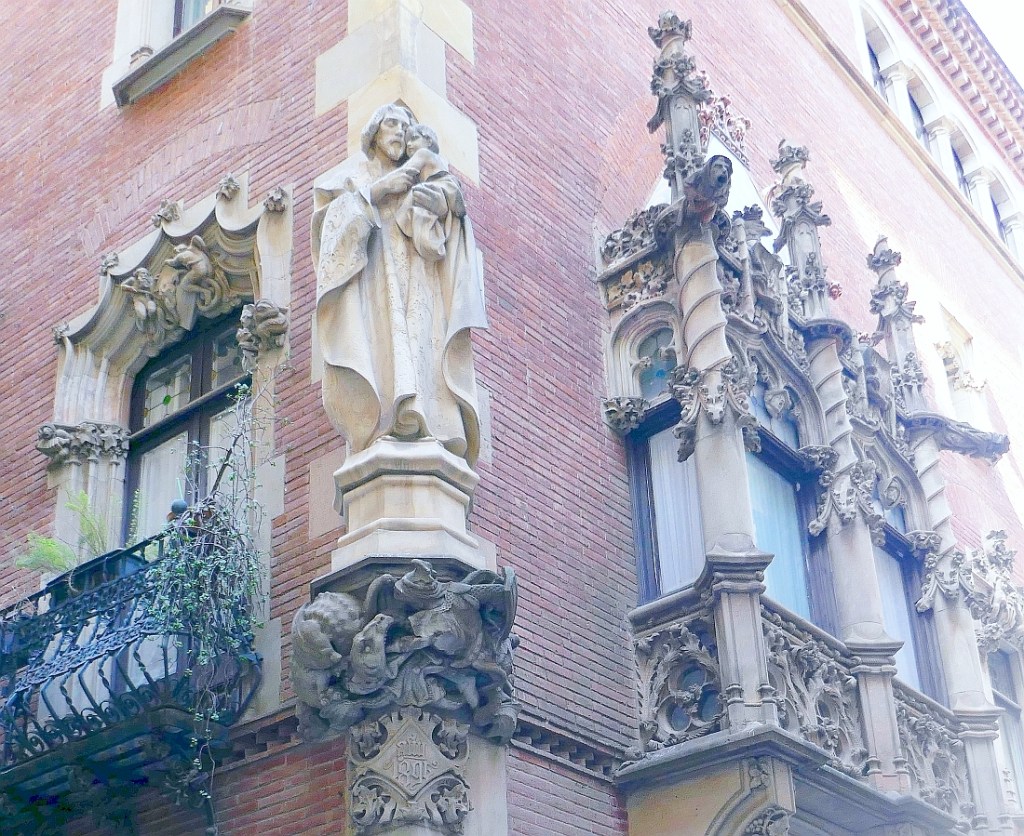
After passing under El Pont del Bisbe without incident, we came to the Church of St Severo (doorway, left below) whose external walls were adorned with a series of sculptures and mosaics. This church is not far from the Cathedral and belongs to the Chapter of the Cathedral. Construction of this church began in 1699.

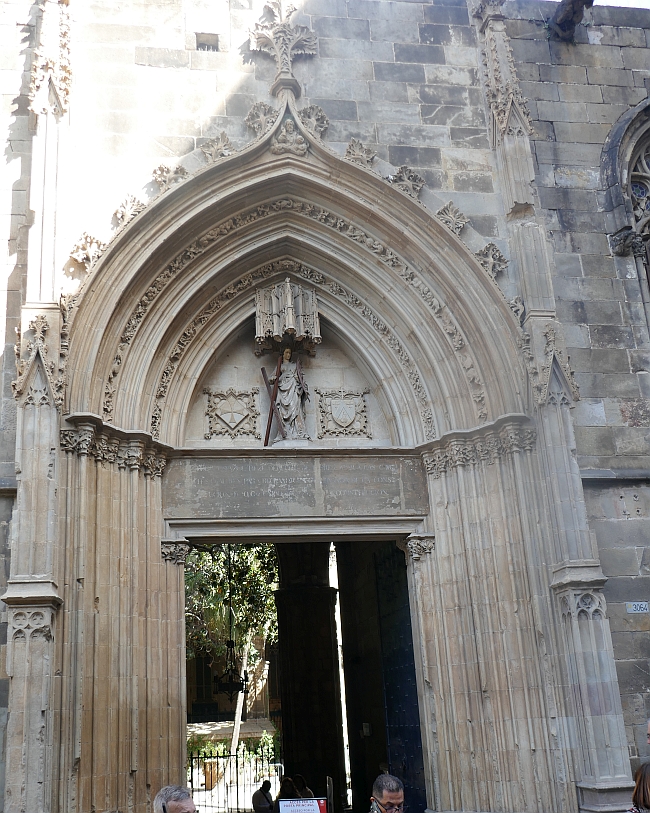


The sculpture on the right above is a particularly significant one for the citizens of Barcelona. It is generally called the Monument to the Heroes and comes from the events between 1807-1814 when Barcelona was occupied by Napoleon’s army. An attempt by 8,000 citizens to overthrow the French troops occurred but was quickly quashed. Five people were convicted by the French and executed in front of the City’s citadel. A second revolt occurred and more citizens were executed. The story of these events is portrayed in various mosaics along the wall of the church.
It was well after lunch time when we passed the Cathedral and crossed over the Placa del Rei. This square in front of the Cathedral is apparently where the famous Spanish Monarchs, Ferdinand and Isabella, graciously received Columbus in the mid 1490s after his return from his voyages of exploration to the new world of the Americas. No doubt he reported in on his discoveries which led to the beginning of the new colonies for Spain in South America which brought an avalanche of gold to the Spanish coffers. If we had followed La Rambla to its end near the port, we would have been able to gaze upon Columbus high on his 60 metre column at the roundabout there, built 400 years later in 1888.
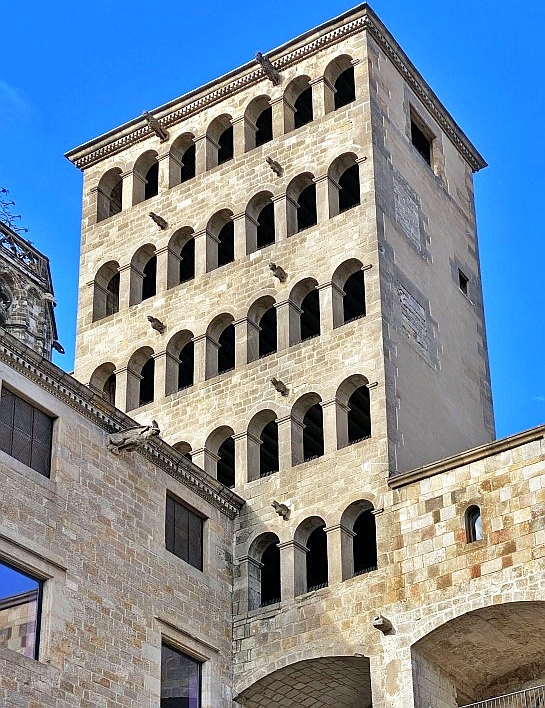
The building to the left below is called Mirador del Rei Marti (King Martin’s Watchtower) on the other side of Placa del Rei next to the Cathedral. It was built in 1302 and was considered one of the tallest buildings in the world at the time.

From the Cathedral precinct we headed through to the Placa de Ramon Berenguer el Gran. Here we found a very pleasant open-air restaurant with views over the square where we could rest our feet and have some lunch. The equestrian statue of Ramon Berenguer was not far from our table and thus ensued a controversial dialogue about the symbolism of the design of the front legs of the horse. It was declared by one of our companions that if the horse had both front legs in the air, the rider died in battle; if only one leg up, the rider was only wounded…etc, etc. Alas for this carefully designed theory about equestrian statues, it is a well-crafted urban legend.
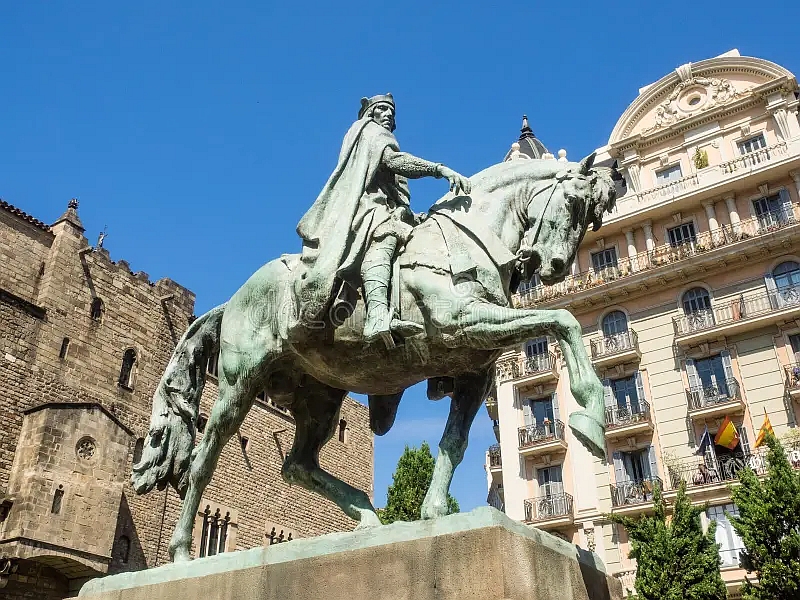
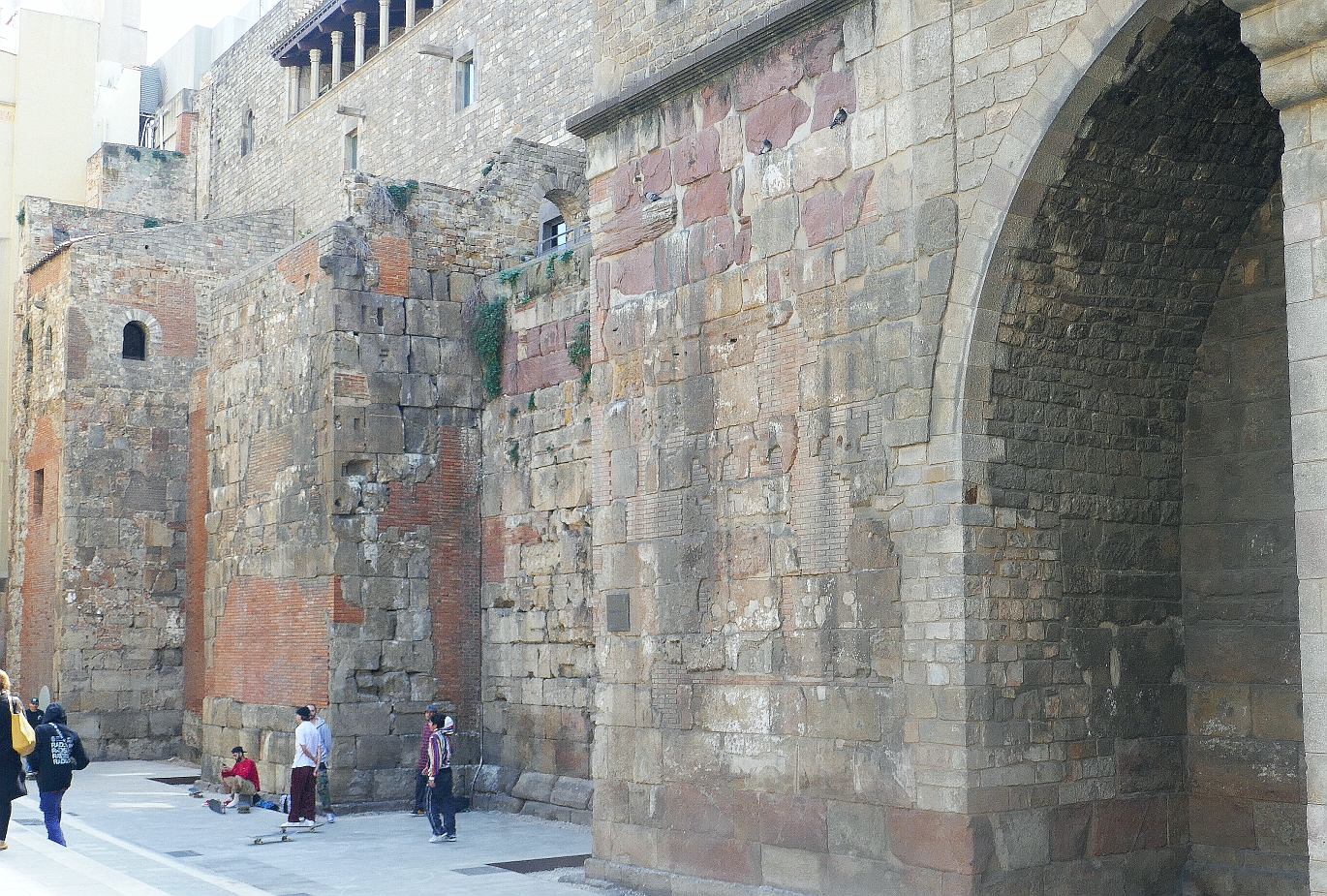

Apart from the food and the equestrian statue, there was plenty of other action in this square during our lunch. There was a group of young guys who appeared to be making a film about what happened to skateboard riders if they took off ‘at full pelt’ over the top of three largish steps, became airborne and failed to stop in time before they hit the ground or the huge stone walls before them. Some of these brave heroes also tried to spin in mid air before they hit the ground or hit the wall. As they say, its all a lot of laughs until somebody gets hurt!
However it wasn’t the skateboarders that were the most significant features worthy of examination in Ramon Berenguer’s Grand Square, it was the stone walls the skaters were bouncing off that were the real attractions here. These walls began to be built by the Romans in the first century CE and have been reinforced a number of times over the centuries in order to upgrade Barcino’s defences against attacks by the Franks and the Alemanni (German Tribes). The conglomeration of different eras of building this wall are obvious in this significant stretch of Roman defences, parts of which are clearly constructed by materials from other buildings.
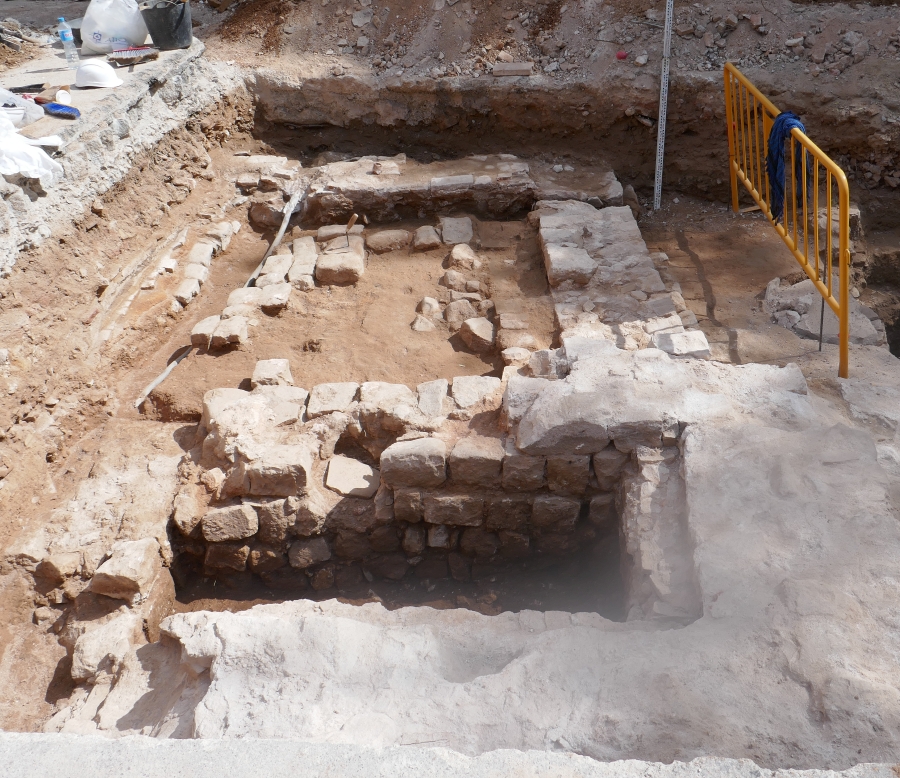
On our walk home, we had difficulty crossing one of the roads near our luncheon square due to the fact that the Barcelona Council workers in their street up-grading works had uncovered more evidence of the Roman origin of this Gothic section of the city. I am sure that these same workers were not happy to find Roman remains as it would mean calling in the archaeologists and delaying their work in upgrading the pedestrian crossing on this street.
Random Roman stones have clearly been dug up during many of the excavations that building new Hotels and Office blocks in Barcelona necessitate. Even the site where our Hotel Catalonia Magdalenes was originally excavated, they found remnants of old Barcino needing to be removed. This time the stones were from the original aqueduct that we had examined the archways of at the start of the day’s walk. The stone on the right is just one of the many Roman stones that the hotel had kept and placed under glass floor tiles in the public area on the bottom floor of the hotel.

 FOGTRAVEL