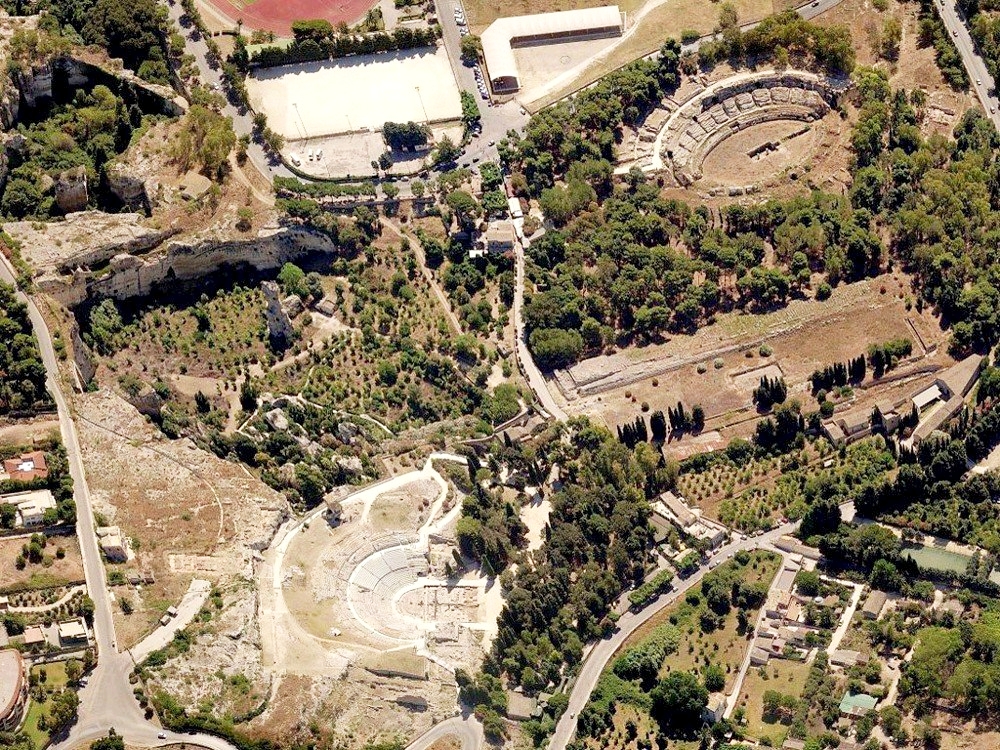
During our rushed time in Catania, Sicily, we decided to catch a train down to Syracuse to visit this famous ancient city. When we got off our train, we were faced with choices that we hadn’t done our researches on so we chose to spend our available time visiting the Neaopolis Archaeological Park rather than visit the old centre of Syracuse. I was able to promise myself that if I ever returned to Sicily with more available time, I would spend it strolling the streets of old Syracuse on the Island of Ortigia.
I am not sure if the status of Syracuse as one of the oldest cities in the Mediterranean is due to its position on the east coast of Sicily, facing back towards the end of the Mediterranean sea where the civilizations of Egypt and Greece flourished. It was Greeks from Corinth who founded this city almost 2,700 years ago. It has a number of famous names associated with it such as Archimedes (287-212 BCE) , the great Mathematician, who was born here. St Paul on his way to Rome stopped in Syracuse for three days and tour guides today will show you the crypt where he apparently said Mass. (I am not sure that the Catholic Mass as a ritual was well developed in St Paul’s time!) Syracuse survived as a powerful city for almost five centuries after it was colonised by Greek Settlers. During the Punic War against Carthage, Syracuse was captured by the Romans and for the next five centuries was a prominent Roman City.
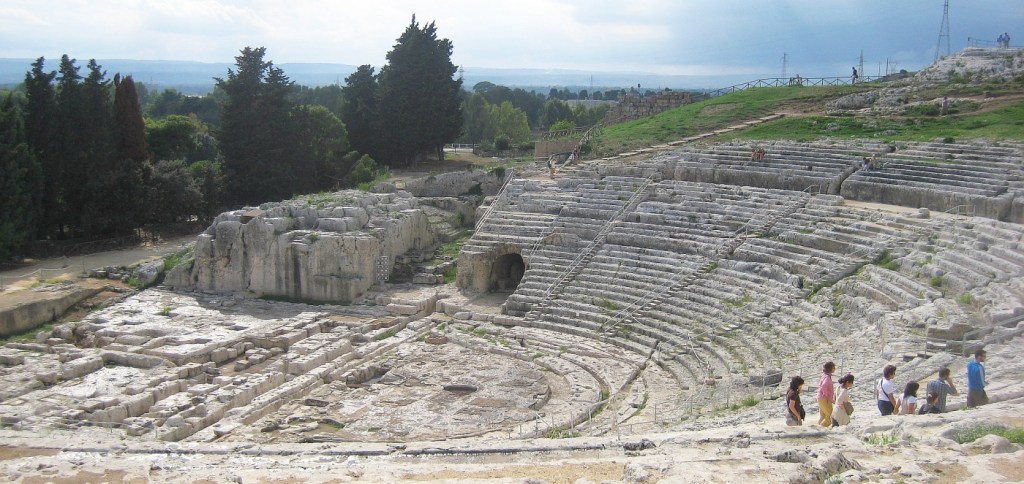
The archaeological Park of Syracuse is where some of the major remnants of the civilizations who ruled Syracuse before the common era are to be found. One of the first sites we visited was the Greek Theatre. This theatre was built some time between the fifth and third century BCE and is considered one of the most important theatres that has survived from the ancient world. It is believed that the famous Greek Playwright Aeschylus wrote plays for this large theatre that could hold over 12,000 spectators. The Theatre is still in use in modern times and visitors can attend performances of Ancient Greek Tragedies here.
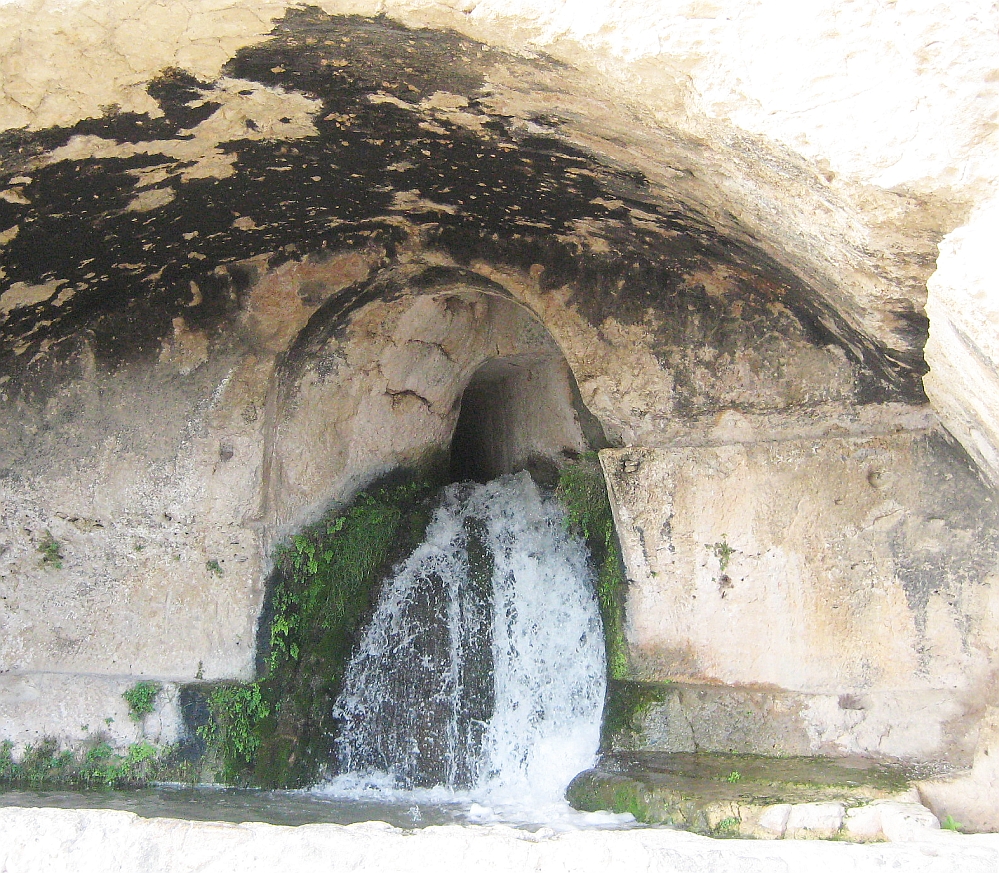
The archaeological park where the ancient Greek and Roman theatres can be explored today was also used as a quarry for building not only the theatres but many other buildings in Syracuse. The ‘caves’ in the surrounding hillsides were also used as graves and at times prisons in Syracuse’s history. Behind the Greek Theatre can be spotted these caves as well and a water feature called the Nympheum.

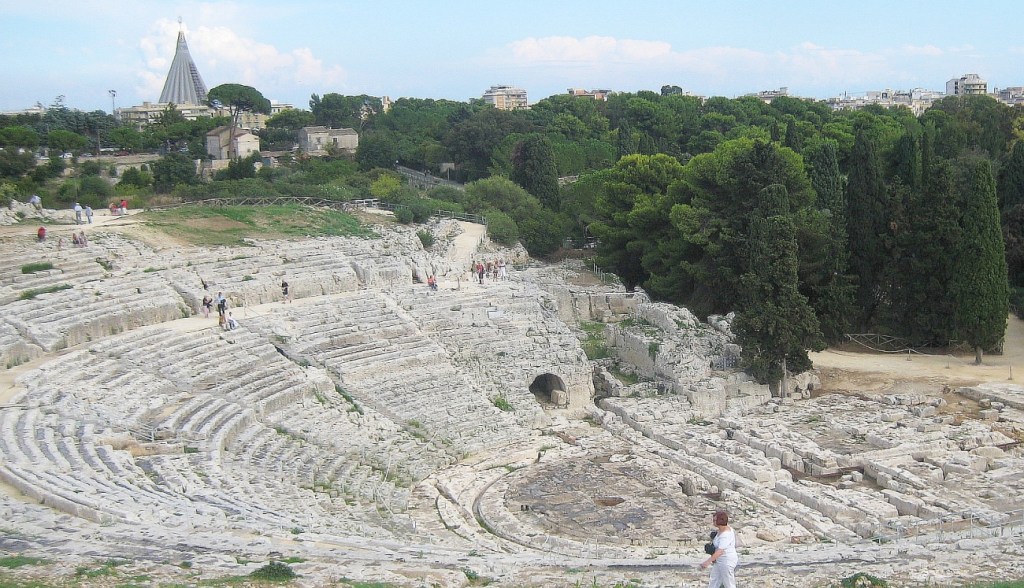
We spent plenty of time exploring the Greek Theatre from all sides. The photo to the left has in the background the Basilica of Madonna delle Lacrime, a late twentieth Century shrine Church that was completed in 1994. It is a controversial church for locals as it was bult to honour a ‘miracle’ where a plaster icon was claimed to have shed tears. Some locals claim the church looks like a tear drop!
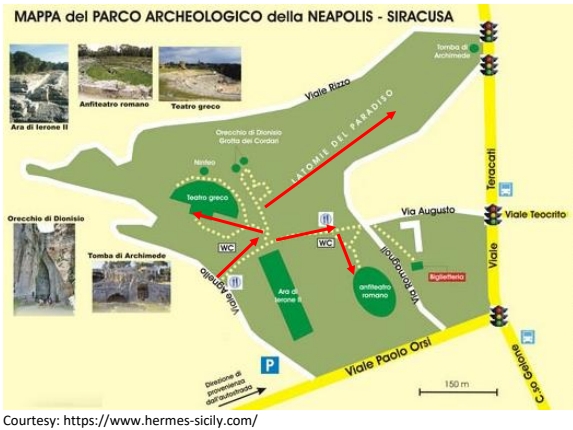
As can be seen in the map of our walk around the park earlier in this blog, our next destination was the Roman Amphitheatre built during the reign of Augustus Caesar (43 to 18 BCE). It was designed like so many arenas in the Roman Empire for more violent entertainment for the Roman masses who didn’t mind a bit of Gladiatorial violence and animal fighting…generally not the classic plays of Aeschylus. In the photo to the right below, an opening can be seen in the centre of the Roman arena where machinery could be drawn from, to support whatever form of blood sport was occurring above in the arena.
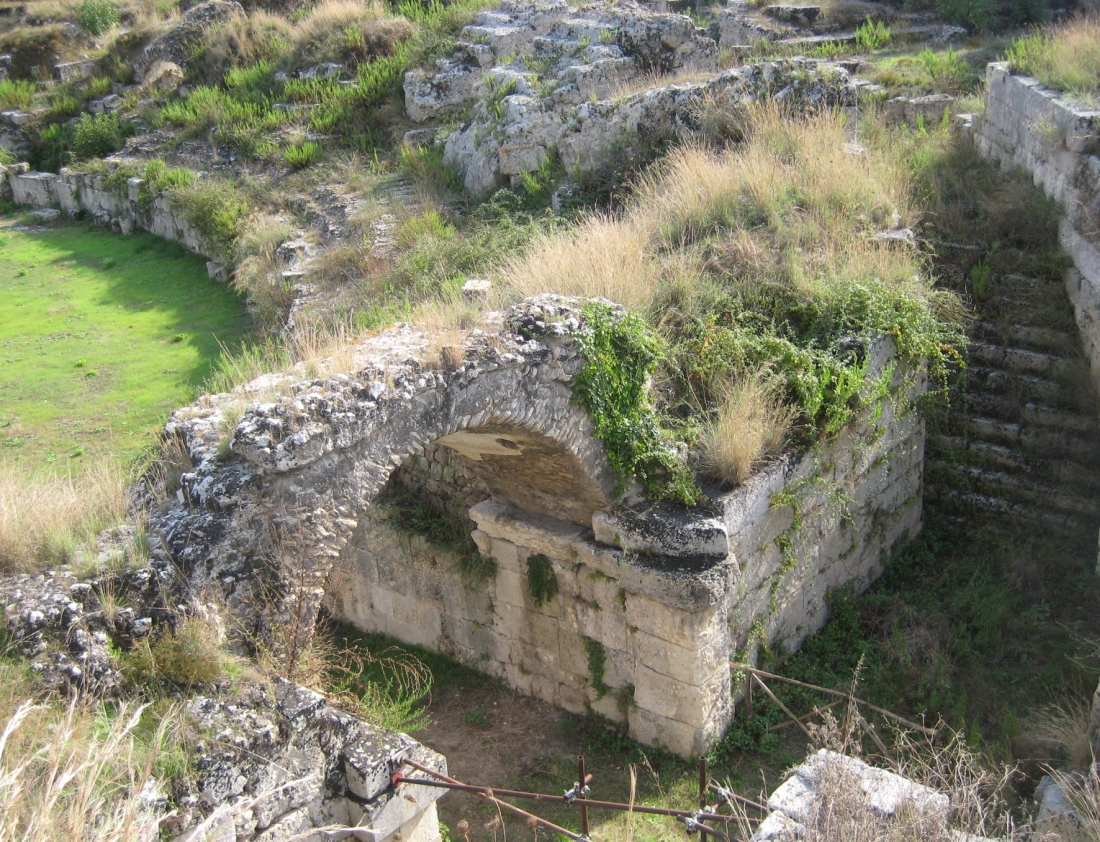
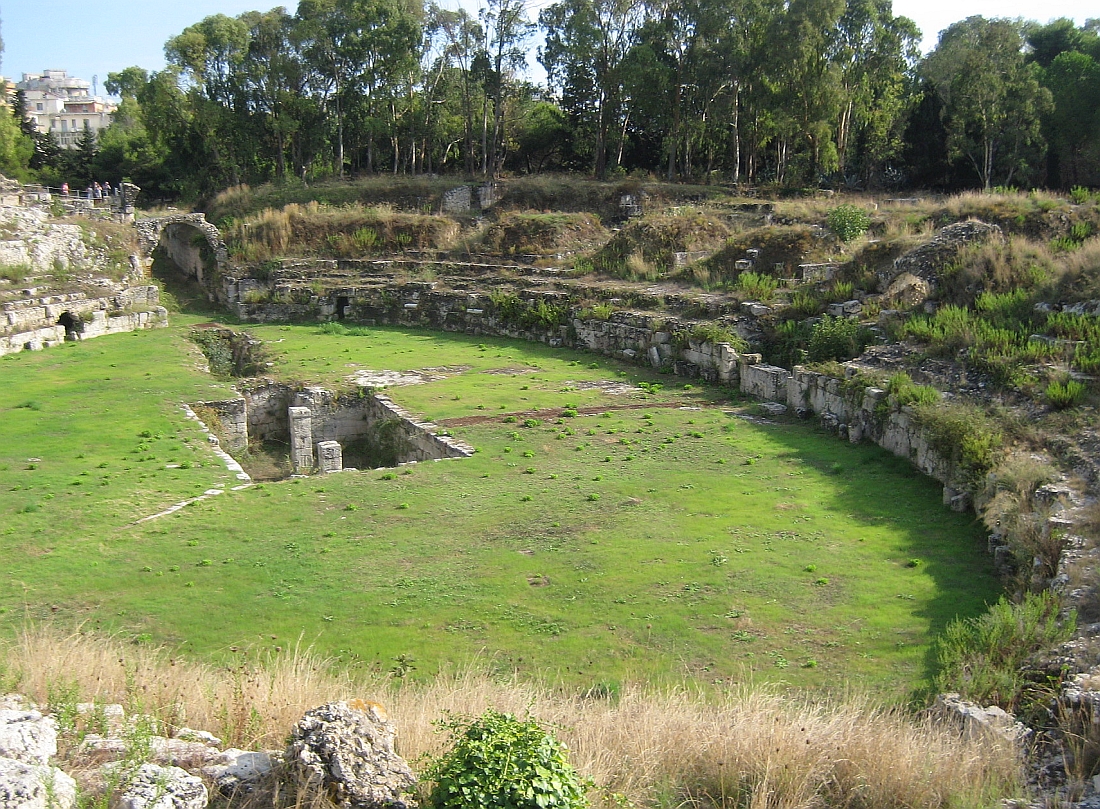
As can be seen in the map of our walk around the park earlier in this blog, our next destination was the Roman Amphitheatre built during the reign of Augustus Caesar (43 to 18 BCE). It was designed like so many arenas in the Roman Empire for more violent entertainment for the Roman masses who didn’t mind a bit of Gladiatorial violence and animal fighting…generally not the classic plays of Aeschylus. In the photo to the right below, an opening can be seen in the centre of the Roman arena where machinery could be drawn from, to support whatever form of blood sport was occurring above in the arena.

The Roman arena is not in as good a shape as the Greek Theatre due to the locals looting the stones in the 16th century for other projects closer to the harbour. It originally had been one of the largest amphitheatres in Italy.
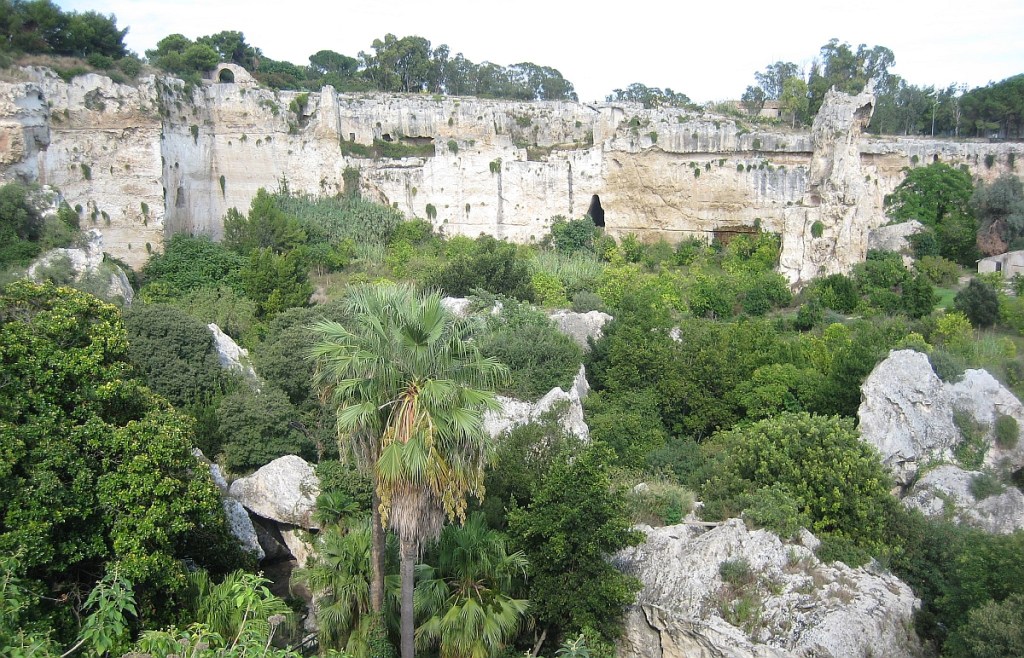
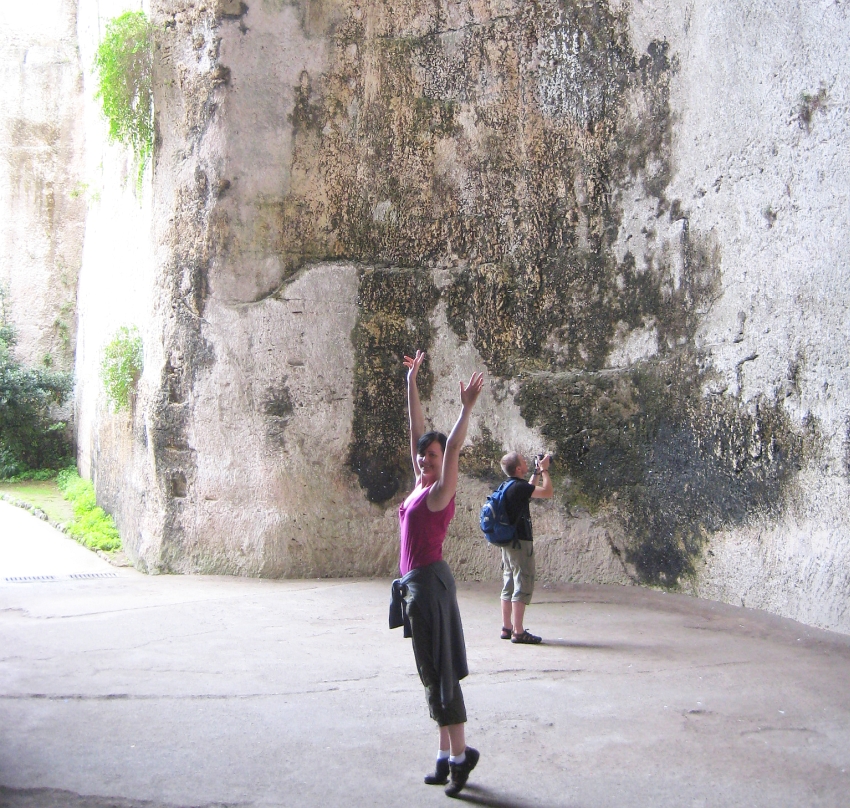
From the Roman Arena we walked back to the area behind the Greek Theatre called the Latomia del Paradiso (the Paradise Stone Quarry). It is no longer an area of rock quarrying or Prison caves, today it has been developed into a garden area. In this landscape is to be found the most famous cave in Syracuse called the ‘Ear of Dionysius’, right below. It reaches 23 metres in height inside and is 60 metres long. It was apparently used by the Greek Tyrant, Dionysius (432-367) as a prison.

It was a very interesting walk around the Neapolis Archaeological Park and so it was a weary couple who managed to find a Taxi back to the Railway Station!
 FOGTRAVEL