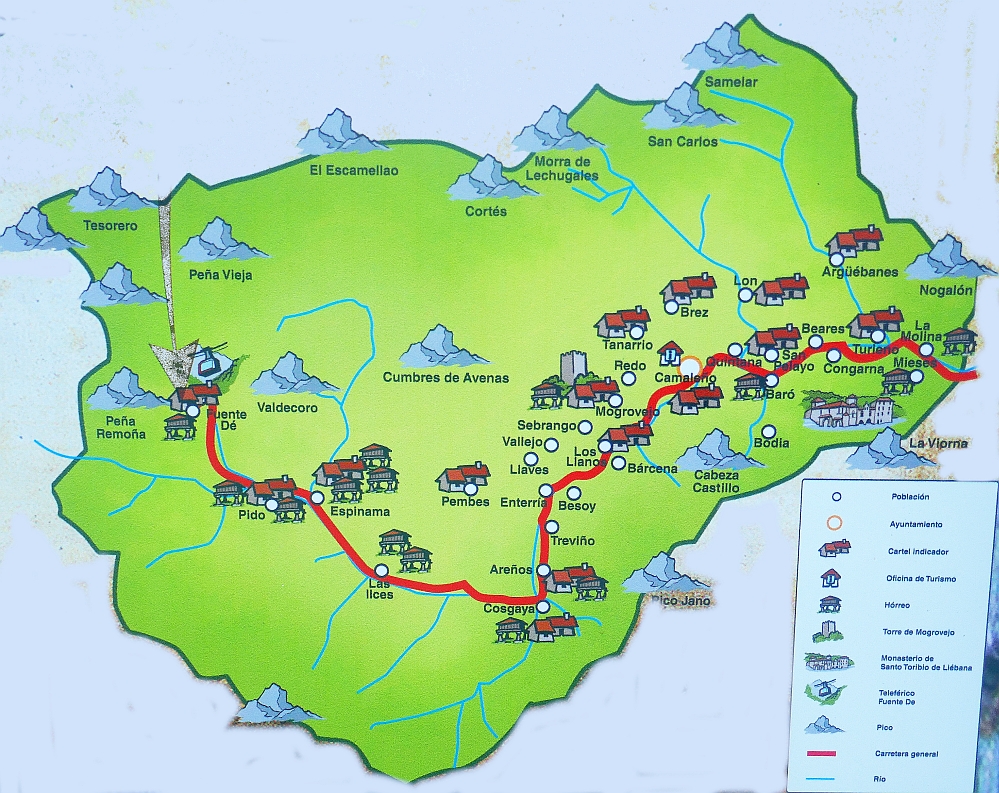
From Altimira we headed south towards the Picos de Europa (The Peaks of Europe) National Park where we would be staying overnight in the very small village of Cosgoya. This National Park straddles the regions of Asturias, Cantabria and Leon in the heart of the Cantabrian Mountains. The map to the right shows that there are many small villages along the road that leads to the end of the road at Puente De, the skiing hiking, mountain climbing centre of the Park. Unfortunately if you make it all the way through the park to Puente De, the ‘Picos of Europa’ block your way and you have to return all the way back through the park to continue the journey west to Santiago de Compestella (if that is your destination).
COSGOYA
Due to our detour via Altimira, Museum we were late arriving at Hotel Cosgoya. It was getting dark but we could see that our hotel was just over the road from the regulation mountain stream and the gorgeous mountain bridge if we were in need for getting over to the other side. We only had a small amount of time to get our gear into our rooms before we were due in the dining room for dinner.

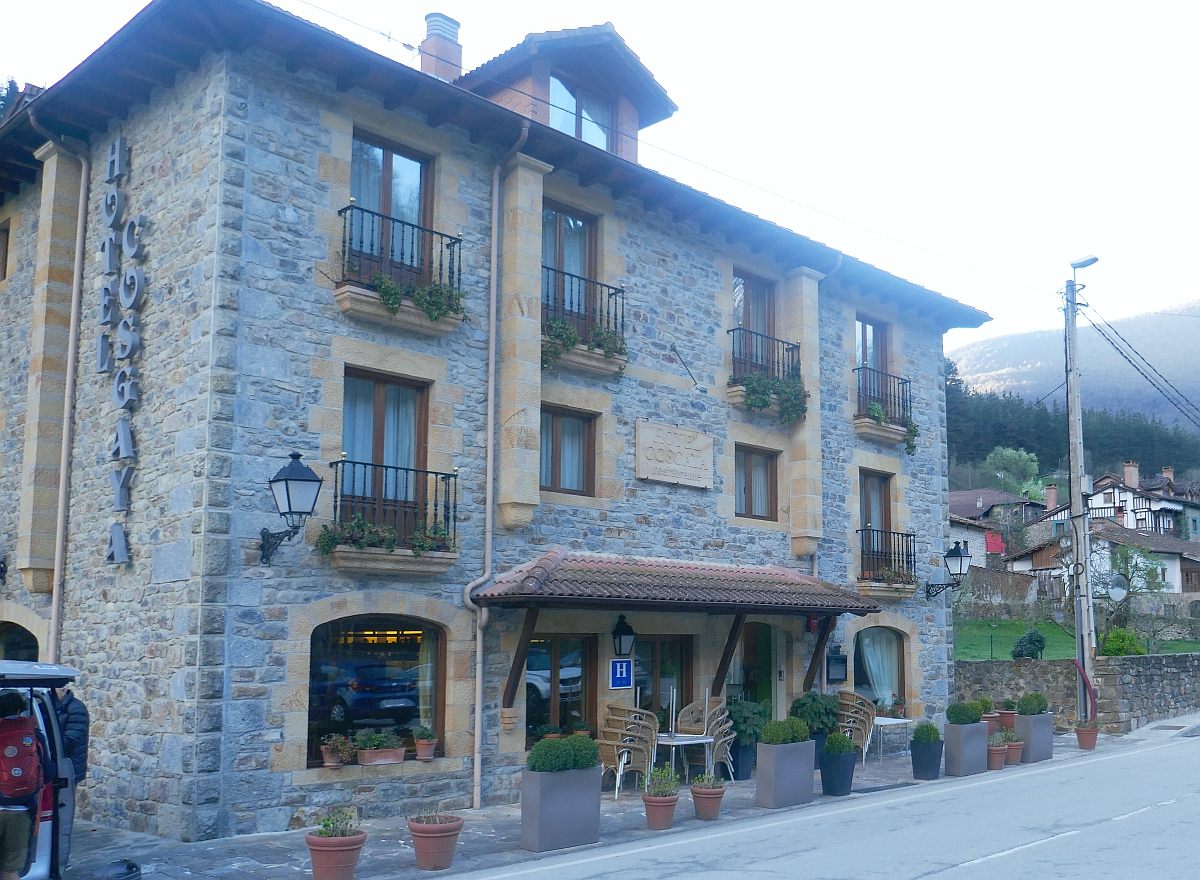
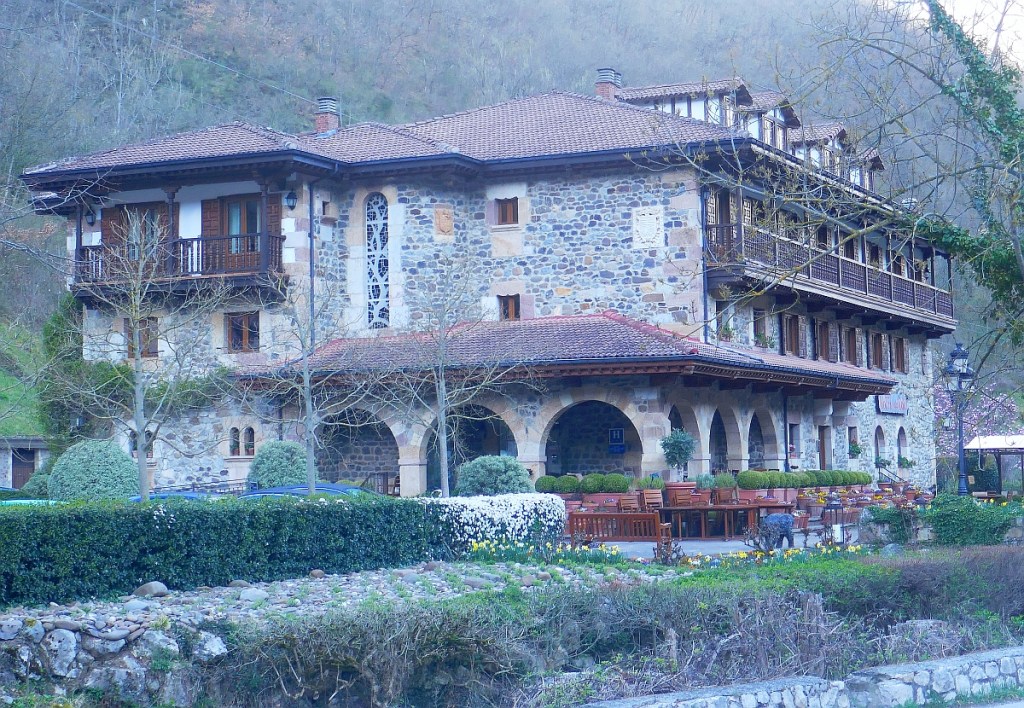
We were able to go for a walk after dinner and check out the big hotel over the road. The town of Cosgoya could be inspected with a short stroll and it had been a long day of travel and tourism so our bed would be welcome place to get ready for our next day of touring Northern Spain.
PUENTE DE

Puente means ‘bridge’ in Spanish so I am not sure whether it referred to the mountains around us as bridges to the next valley or the next world. We were surrounded in the car-park by large mountains (above is the mountain Valdecoro) and the place we found ourselves in was clearly the centre of all things alpine in the area. Skiing and hiking were not on our agenda but our guide took us for a walk in the mountain meadows over the road from the National Park Visitor Centre where we were to meet up with some hardy alpine ponies who happily completely ignored us.
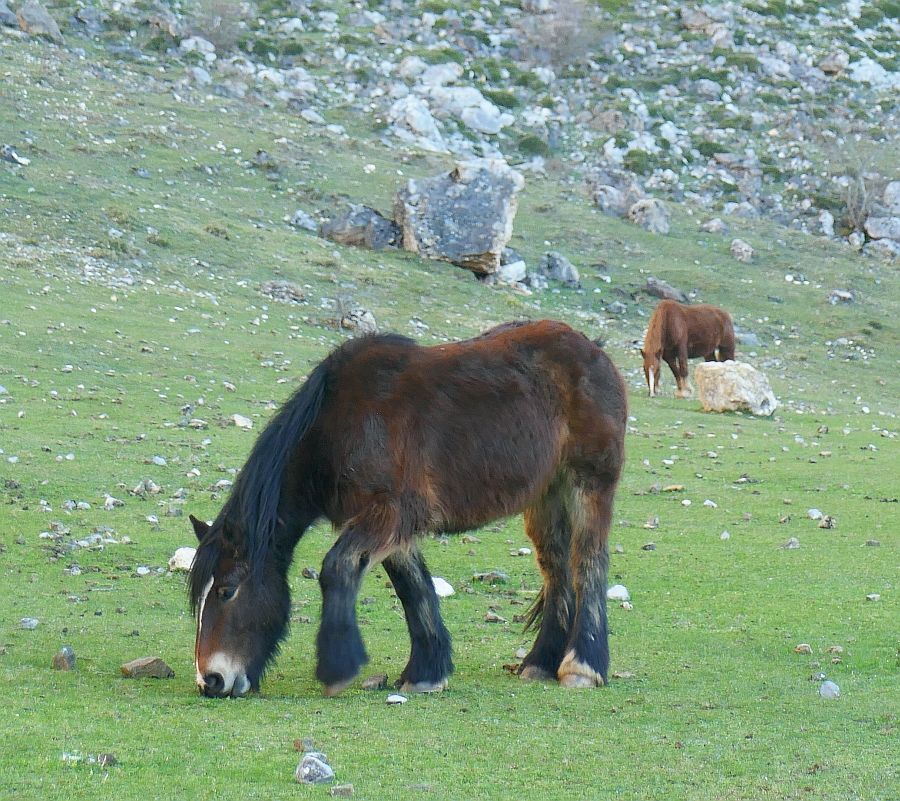

The pony field also happened to include a pathway for the hikers and mountain climbers who headed quite happily past us to climb the mountains that looked far too steep and rugged for normal humanity to climb. Our guide decided to illustrate how easy it was to climb the sheer walls of the mountains and went for a 30 minute stroll up a narrow mountain pathway while we gazed on in admiration.


From Puente De we returned back along the National Park Road to our next visiting site Mongrovejo.
MONGROVEJO

Mongrovejo was described to us a bit like a ghost town and we certainly didn’t meet up with many people there (officially 44 citizens). However it was the usual beautiful small town within the Liebana Valley and the Andara Massif was not many kilometres away. Our guide informed us that the town’s main claim to fasme was its ‘Tower of Pedro Ruiz de Mongrovejo” which has survived here since the 13th century. We went for a walk up the hill to inspect the tower and there were no citizens around to question our curiosity. Our guide was not sure of the function of the tower. However there was a battle in this valley back in the 8th century when the Muslim invaders of Spain were defeated for the first time and is considered the beginning of the ‘Reconquista’, the long battle to push the Muslim armies out of Spain.
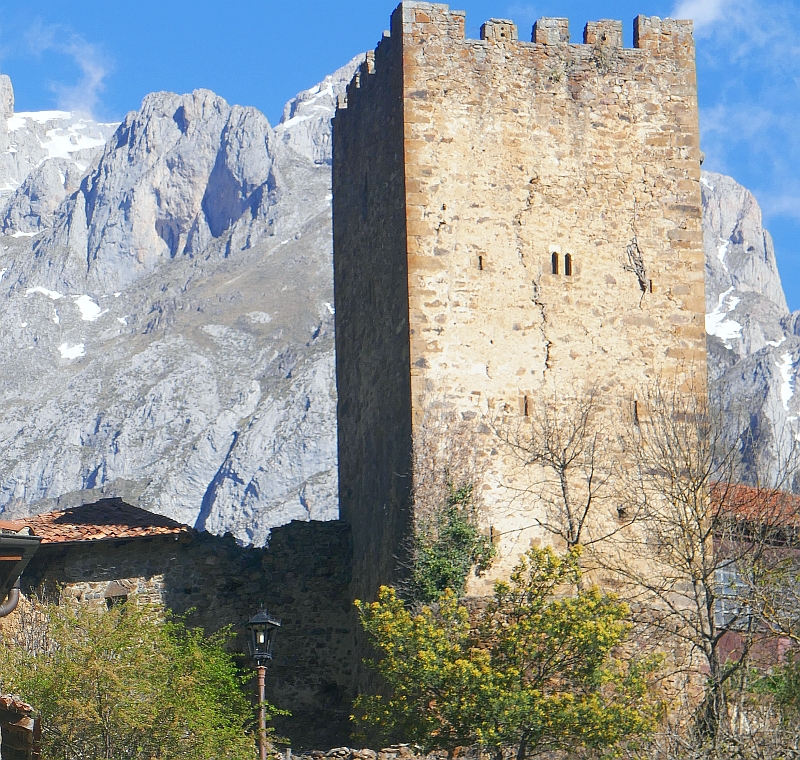
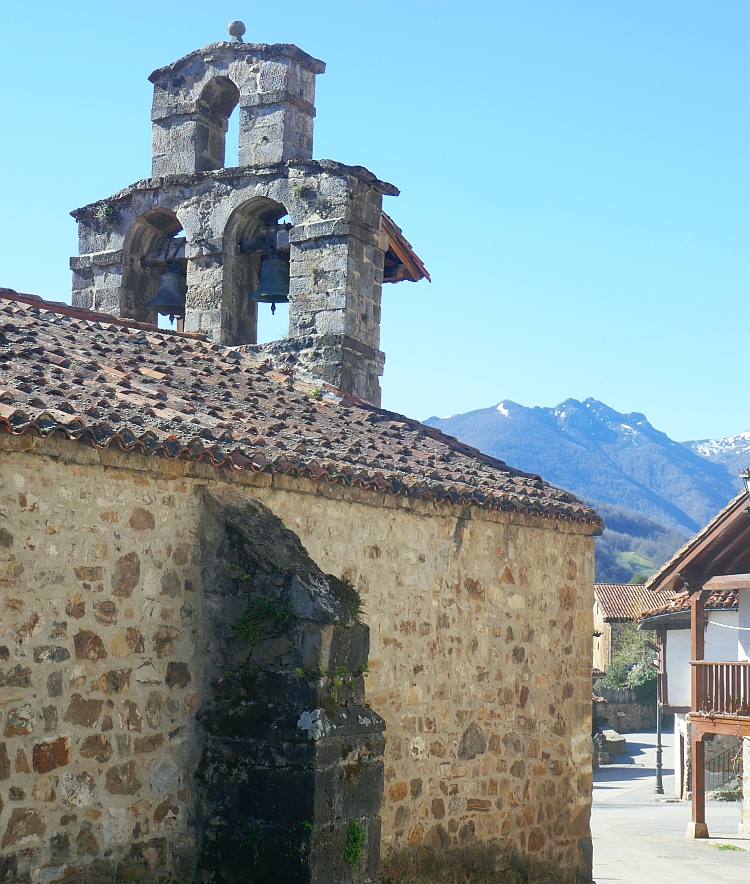
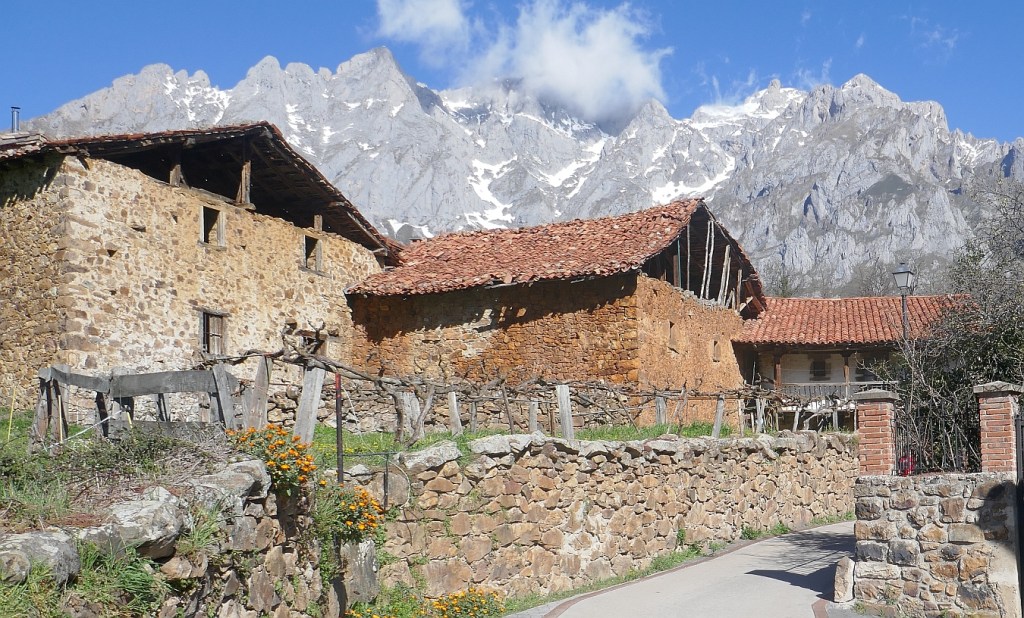
From the tower we explored the rest of the village, coming across a 17th century church called “Our Lady of the Assumption”. We had parked our van just outside the village so we had an interesting walk on the way back through streets where the houses hailed from the 17th/18th centuries.

Monastery of Saint Toribio
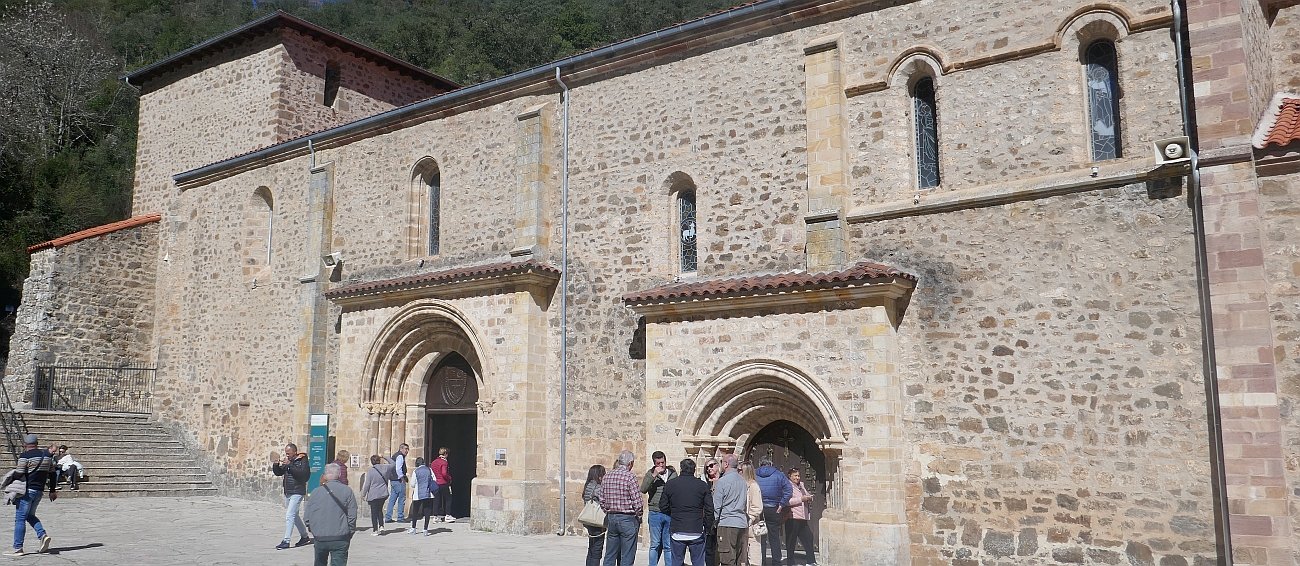
From Mongrovejo it was not that far to our next destination which in this case wasn’t a small village but the large Monasterio de Santo Toribio de Liebana. This monastery was founded in the sixth century by a Bishop of Palencia who retired with some companions to live according to the Benedictine Rule. In the 8th century, the body of another 6th century bishop, St Turibus was moved here and with it came relics that were believed to have been brought by him from the Holy Land. The most significant of these relics was believed to be the largest piece of the True Cross to have been recovered during the Crusades. The ‘True Cross’ was believed to have been unearthed by St Helena (Mother of Roman Emperor Constantine I) and brought to Spain by St Turibus.
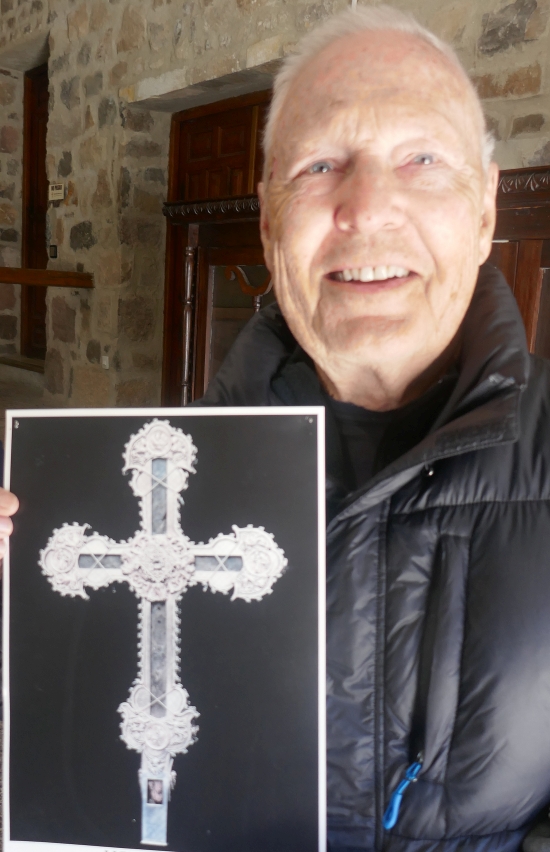
The monastic community that lived here ceased to exist after the forced sale of religious land in 1837. In 1961 a small community of Franciscan Monks (Friars Minor) took over the monastery. The person photographed to the right above is not a minor friar but a member of our curious travelling group.

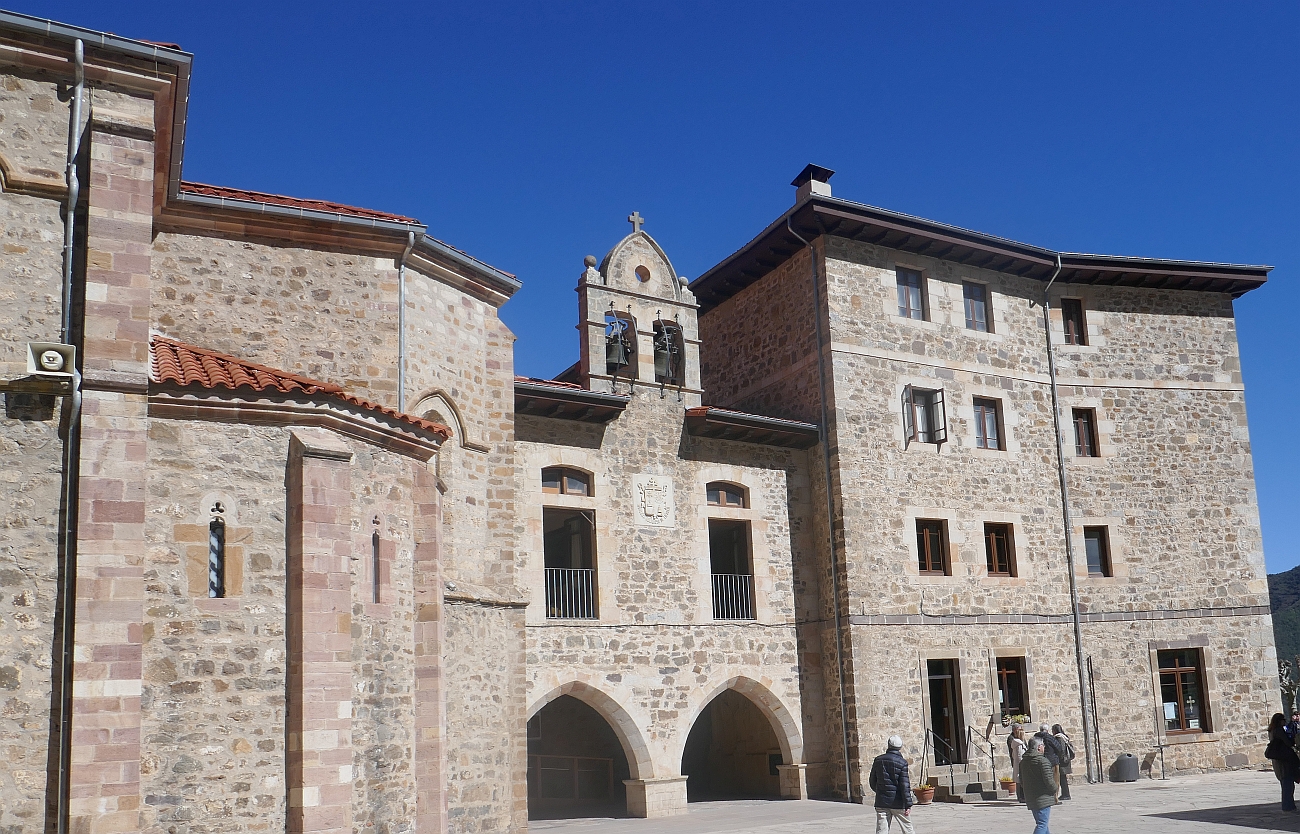
A mass was just finishing in the monastery church but there were some devotions after mass that we were able to be present at, based around the holy relics of the site. After this finished, we were able to inspect the church and the rest of the grounds of the monastery.

POTES


Whilst not the capital of the Cantabria region, Potes is considered by locals and tourist operators as the most attractive town in the area. The above image shows the River Quiviesa flowing through the centre of town. The town dates back to the 14th century and there seems to be plenty of interesting buildings that span the last 5 centuries. Archaeologists have found little trace of prehistoric occupation but like everywhere in Spain, the Romans have been here and they named the place Pontes. Perhaps the most devastating event in the history of the town was in the 20th century when as part of the civil war, the town was hit by fire which destroyed the old town. It has clearly been rebuilt.
We had had a busy morning of visiting places in the valley so lunch was the first thing on our mind rather than a tour of the town. However we were lucky to find a table outside a café that overlooked the Rio Quiviesa. We couldn’t have been any closer or we would have been over the stone wall that prevented us from falling down the slope into the river. Our table also gave us a great view down to the river and along to the the picturesque ‘La Casuca del Ponte’ as can be seen in the photo on the left below. Apart from a great lunch, our guide tried to introduce us to the traditional system of drinking cider in this valley. It involved ordering a bottle of local cider, pouring it into a glass from a great height and then hopefully getting most of the cider into the glass. It was good that we were outdoors so nobody got too wet!
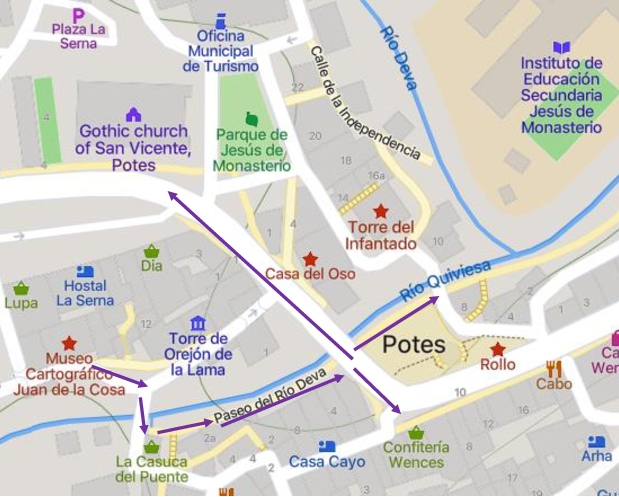


We passed the old Gothic Church of San Vincente (see photo left above) which was originally built in the 15th century. It was replaced in the 19th century. The most imposing building in town is the Torre del Infantado which was built in the 15th century as well (On left below). It now houses the City Council.


After lunch we went for a short walk around town but we needed to hit the road to our next stop which was 165 kilometres west and involved a drive back to the northern coastline before we could turn left and headed towards Oviedo.
 FOGTRAVEL